

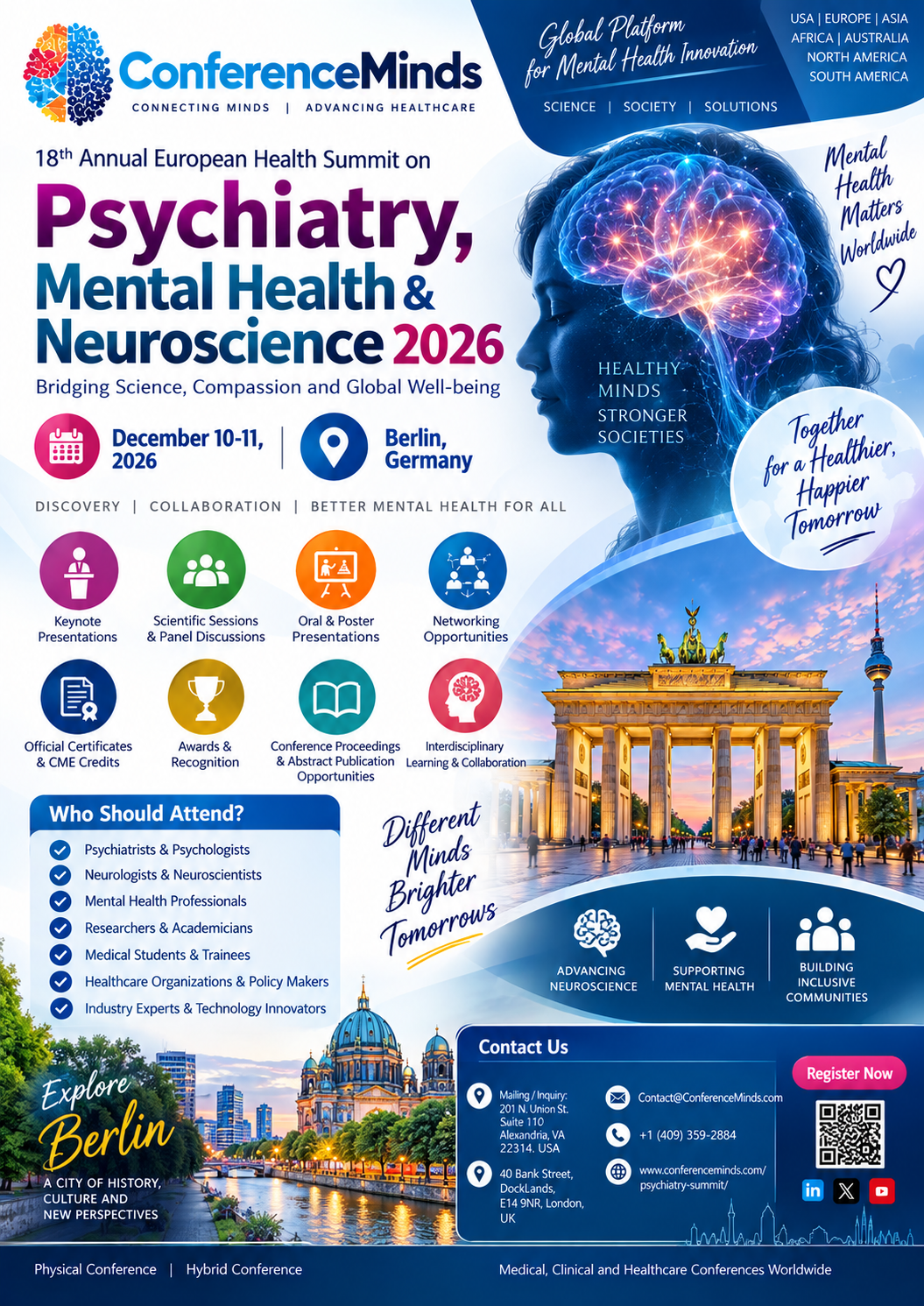
18th Annual European Health Summit
on
Psychiatry, Mental Health & Neuroscience 2026
Event Date
December 10-11, 2026
Venue
Berlin, Germany
– Previous Conference Performers / Professionals From Around The Globe –










































Media Partners/Collaborator
A huge thanks to all our amazing partners. We couldn’t have a conference without you!










Sponsors/Exhibitors
A huge thanks to all our amazing partners. We couldn’t have a conference without you!
About the Conference
The 18th Annual European Health Summit on Psychiatry, Mental Health & Neuroscience 2026 will be held on December 10–11, 2026, in Berlin, Germany. The summit will bring together psychiatrists, neurologists, neuroscientists, psychologists, mental-health professionals, researchers, clinicians, academics, healthcare providers, pharmaceutical and biotechnology professionals, and technology innovators to exchange knowledge and discuss emerging developments across psychiatry, neuroscience, and mental healthcare.
The scientific program will explore contemporary approaches to the prevention, diagnosis, treatment, and management of psychiatric and neurological conditions. Key areas will include depression, anxiety, psychosis, neurodegenerative disorders, addiction, child and adolescent mental health, psychiatric genetics, brain stimulation, digital psychiatry, artificial intelligence, and personalized mental healthcare.
The summit will provide opportunities for keynote presentations, scientific sessions, oral and poster presentations, panel discussions, networking, and interdisciplinary collaboration, encouraging participants to share research findings and explore future directions in mental healthcare.
Sessions and Tracks
1. Advances in Psychiatry and Psychotherapy
Exploring contemporary diagnostic approaches, therapeutic strategies, clinical guidelines, and emerging models of psychiatric care.
2. Depression and Mood Disorders
Current research on major depressive disorder, bipolar disorder, treatment-resistant depression, mood regulation, and innovative therapeutic interventions.
3. Anxiety, Stress and Trauma
Discussion of anxiety disorders, chronic stress, trauma-related conditions, PTSD, resilience, and evidence-based psychological and pharmacological interventions.
4. Schizophrenia and Psychotic Disorders
Recent developments in understanding psychosis, schizophrenia, early intervention, antipsychotic treatment, rehabilitation, and recovery-oriented care.
5. Child and Adolescent Mental Health
Focus on developmental psychiatry, childhood anxiety, depression, ADHD, autism, behavioral disorders, early intervention, and family-centered care.
6. Geriatric Psychiatry and Healthy Brain Aging
Research into cognitive aging, late-life depression, dementia-related behavioral symptoms, loneliness, and strategies supporting healthy aging.
7. Neurodegenerative Diseases and Dementia
Advances in Alzheimer’s disease, Parkinson’s disease, frontotemporal dementia, biomarkers, neuroinflammation, prevention, and emerging therapies.
8. Clinical Neuroscience
Connecting neuroscience research with clinical psychiatry through studies of brain circuits, cognition, behavior, neurobiology, and disease mechanisms.
9. Neuropsychiatry
Examining the interaction between neurological and psychiatric disorders, including behavioral symptoms associated with neurological disease.
10. Psychiatric Genetics and Genomics
Exploring genetic susceptibility, gene–environment interactions, genomic medicine, biomarkers, and personalized approaches to psychiatric disorders.
11. Brain Imaging and Neurodiagnostics
Latest applications of MRI, PET, functional imaging, electrophysiology, and computational approaches for understanding brain and mental disorders.
12. Addiction Psychiatry
Research and clinical practice relating to substance-use disorders, behavioral addictions, prevention, rehabilitation, and integrated treatment.
13. Digital Psychiatry and Telepsychiatry
Examining remote mental-health services, digital therapeutics, mobile applications, virtual care, accessibility, and technology-supported clinical practice.
14. Artificial Intelligence in Mental Healthcare
Applications of AI and machine learning in screening, diagnosis, risk assessment, treatment personalization, clinical decision support, and research.
15. Precision and Personalized Psychiatry
Exploring biomarkers, patient stratification, individualized treatment selection, and data-driven approaches to psychiatric medicine.
16. Psychopharmacology and Novel Therapeutics
Recent developments in antidepressants, antipsychotics, mood stabilizers, novel drug targets, treatment strategies, and medication safety.
17. Psychotherapy and Psychosocial Interventions
Evidence-based approaches including CBT, psychotherapy, behavioral interventions, family therapy, mindfulness, and integrated psychosocial care.
18. Global Mental Health
Public-health approaches to mental illness, healthcare inequalities, prevention, mental-health access, workforce development, and international collaboration.
19. Forensic Psychiatry
Exploring psychiatric assessment in legal settings, risk assessment, rehabilitation, ethics, and the relationship between mental health and criminal justice.
20. Integrative and Holistic Psychiatry
Discussion of lifestyle interventions, mindfulness, sleep, nutrition, physical activity, complementary approaches, and whole-person mental healthcare.
21. Women’s Mental Health and Perinatal Psychiatry
Focus on perinatal depression, postpartum mental health, reproductive transitions, hormonal influences, and gender-responsive psychiatric care.
22. Neuromodulation and Brain Stimulation
Recent research involving TMS, ECT, deep brain stimulation, emerging neuromodulation technologies, and their psychiatric and neurological applications.
23. Sleep, Circadian Rhythms and Mental Health
Exploring insomnia, sleep disorders, circadian biology, sleep-related psychiatric symptoms, and the relationship between sleep and brain health.
24. Mental Health Policy, Ethics and Healthcare Systems
Discussion of ethical challenges, healthcare delivery, patient rights, mental-health policy, service integration, and sustainable care models.
25. Future Directions, Young Researchers and Innovation
A multidisciplinary platform for emerging researchers to present new findings, discuss innovative concepts, and explore future directions in psychiatry, mental health, and neuroscience.
Market Analysis
The global mental-health sector is undergoing significant transformation, supported by increasing recognition of mental disorders, growing demand for psychological and psychiatric services, advances in neuroscience, and expanding investment in digital healthcare. The ConferenceMinds conference page identifies several major growth drivers, including increasing awareness, rising demand for treatment, telepsychiatry, AI-based diagnostics, pharmaceutical innovation, government initiatives, and digital mental-health platforms.
The convergence of psychiatry, neuroscience, biotechnology, pharmaceuticals, and digital health is creating new opportunities for research and healthcare innovation. Digital psychiatry and telemedicine are expanding access to mental-health services, while artificial intelligence and computational approaches are being investigated for screening, clinical decision support, patient monitoring, and personalized treatment.
Europe represents an important environment for psychiatric and neuroscience research. Germany has substantial healthcare, pharmaceutical, biotechnology, and academic infrastructure, while Berlin hosts major research institutions and interdisciplinary collaborations. Charité Mental Health, for example, integrates psychiatric and psychological research with clinical care and collaborates with institutions including the Max Delbrück Center, Free University of Berlin, Humboldt University of Berlin, and other research partners. Its infrastructure includes multi-omics, digital and computational, and clinical-trials platforms.
Berlin’s broader healthcare innovation ecosystem also attracts international participation. DMEA 2026, one of Europe’s major digital-health events, brought together experts from medicine, business, science, and technology, with more than 800 exhibitors scheduled to participate.
The neuroscience ecosystem is similarly active. The Einstein Center for Neurosciences Berlin’s 2026 meeting brings together neuroscientists from different career stages and internationally recognized researchers, demonstrating the city’s continuing role as a hub for neuroscience collaboration.
Against this background, the summit can provide an interdisciplinary platform connecting clinical practice, academic research, pharmaceutical development, digital technologies, and emerging neuroscience, while facilitating professional networking, knowledge exchange, research collaborations, and discussion of future opportunities in mental healthcare.
Venue
Berlin, the capital of Germany, is a vibrant international city known for its rich history, cultural diversity, scientific excellence, and modern innovation. As one of Europe’s most influential cities, Berlin offers an ideal setting for international conferences, academic meetings, healthcare summits, and professional networking events.
The city combines historic landmarks with contemporary architecture, world-class research institutions, universities, hospitals, museums, and technology companies. Visitors can explore iconic attractions such as the Brandenburg Gate, Reichstag Building, Museum Island, Berlin Cathedral, and the Berlin Wall Memorial. Berlin’s diverse culinary scene, lively neighborhoods, parks, and cultural events also provide an enjoyable experience beyond conference activities.
Berlin is well connected to major European and international destinations through Berlin Brandenburg Airport and an extensive public transportation network of trains, trams, buses, and underground services. Its efficient infrastructure makes it convenient for delegates traveling from different countries.
For healthcare and scientific professionals, Berlin provides opportunities to connect with researchers, clinicians, academics, industry experts, and institutions from Germany and around the world. The city’s international atmosphere and strong academic and research environment make it a suitable destination for knowledge exchange, collaboration, and professional networking.
With its combination of history, innovation, culture, research, and international connectivity, Berlin offers conference participants both a productive professional environment and an enriching European travel experience.
– Tracks & Key Topics –
- Psychiatry
- Mental Health
- Neuroscience
- Psychiatry Conference
- Mental Health Conference
- Neuroscience Conference
- European Health Summit
- Psychiatry Summit
- Mental Health Summit
- Neuroscience Summit
- Psychiatric Disorders
- Mental Health Disorders
- Neuropsychiatry
- Clinical Psychiatry
- Behavioral Health
- Psychological Disorders
- Cognitive Neuroscience
- Clinical Neuroscience
- Brain Health
- Brain Disorders
- Neurobiology
- Neuropsychology
- Psychopharmacology
- Psychiatric Research
- Mental Health Research
- Neuroscience Research
- Psychiatric Treatment
- Mental Health Care
- Psychiatric Rehabilitation
- Psychotherapy
- Depression
- Anxiety Disorders
- Bipolar Disorder
- Schizophrenia
- Psychosis
- Addiction Psychiatry
- Child Psychiatry
- Adolescent Psychiatry
- Geriatric Psychiatry
- Community Psychiatry
- Social Psychiatry
- Emergency Psychiatry
- Consultation-Liaison Psychiatry
- Forensic Psychiatry
- Biological Psychiatry
- Integrative Psychiatry
- Personalized Psychiatry
- Precision Psychiatry
- Digital Psychiatry
- Digital Mental Health
- AI in Mental Health
- Artificial Intelligence in Psychiatry
- Mental Health Technology
- Telepsychiatry
- Digital Therapeutics
- Brain Imaging
- Neuroimaging
- Cognitive Disorders
- Neurodevelopmental Disorders
- Neurodegenerative Disorders
- Dementia
- Alzheimer’s Disease
- Parkinson’s Disease
- Sleep Disorders
- Stress Management
- Trauma and Mental Health
- Suicide Prevention
- Mental Health Awareness
- Global Mental Health
- Public Mental Health
- Psychiatric Nursing
- Mental Health Professionals
- Psychologists
- Psychiatrists
- Neurologists
- Neuroscientists
- Mental Health Practitioners
- Healthcare Professionals
- Psychiatric Innovation
- Mental Health Innovation
- Brain Science
- Behavioral Neuroscience
- Affective Neuroscience
- Cognitive Psychology
- Clinical Psychology
- Psychiatric Genetics
- Neuropharmacology
- Neuroimmunology
- Brain Research
- Mental Wellness
- Emotional Health
- Psychological Wellbeing
- Mental Healthcare Innovation
- International Psychiatry Conference
- International Mental Health Conference
- International Neuroscience Conference
- European Psychiatry Conference
- Berlin Psychiatry Conference
- Psychiatry Conference Germany 2026
- Mental Health Conference Berlin 2026