
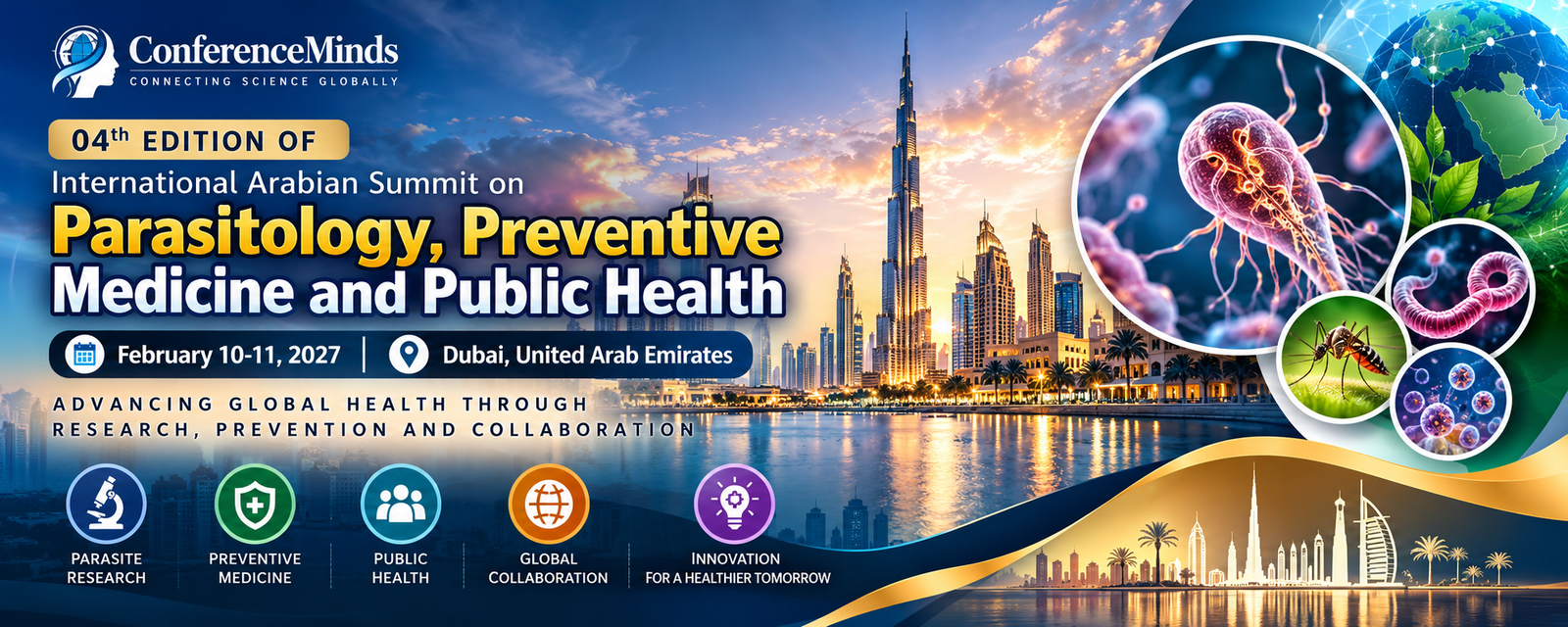
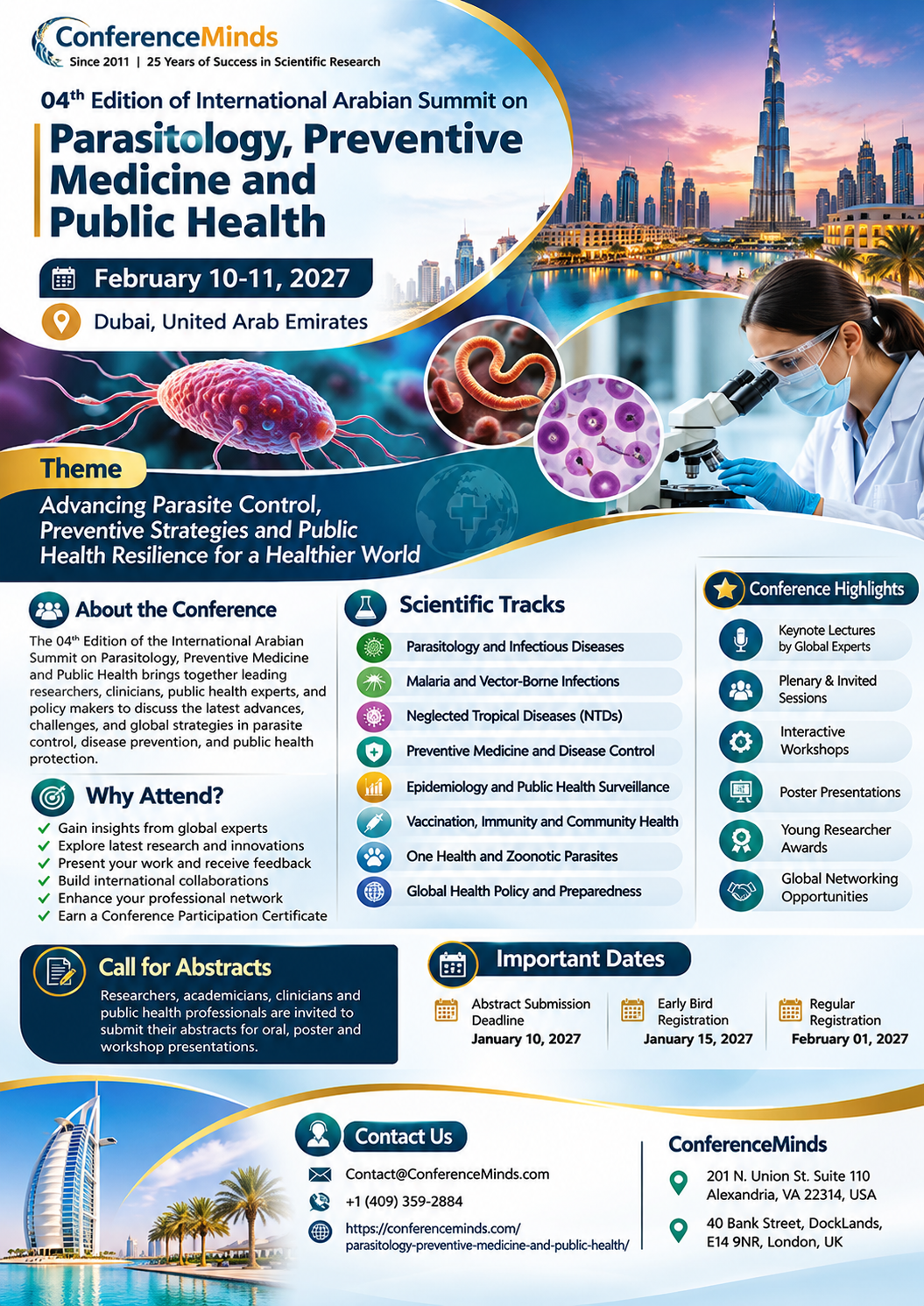
04th Edition of International Arabian Summit
on
Parasitology, Preventive Medicine and Public Health
Event Date
February 10-11, 2027
Venue
Dubai, United Arab Emirates
– Previous Conference Performers / Professionals From Around The Globe –

Ahmed Ali
- Diyala University, Iraq

Aikaterini Ziaka
- Physio4you, Greece

AMR Hawal
- Professor, Prime Healthcare Group UAE

Antonio Steardo
- University of Salerno, Italy

Ashraf Lotfy Fayed
- ENT Military Hospital, Egypt

Aspazija Sofijanova
- Director of Pediatric Clinic, Macedonia

Brandon P. Lucke-Wold
- University of Florida, Florida

Brankica Vasiljevic
- NMC Royal Hospital, UAE

Bruce Ogden
- Director of Operations US Foods USA

Cornelia Beyer
- University of Hull, UK

Gabriela Barsov
- Macedonia

Grazzia Rey
- University of the Republic, Uruguay

Hadi Salloum
- UAE

Heather Carmello
- University of Rochester, USA

Howard Weber
- Penn State Hershey Childrens Hospital, USA
Ilknur AydınAvci
- Turkey

Irene Hamrick
- University of Cincinnati, USA

Jacek Ciesielski
- Medical University of Lodz, Poland

José De Jesús Curiel Valdés
- Clínical Patology, Mexico

Lloyd L. Tran
- Biomed Industries, USA

Luca Roncati
- University Hospital of Modena, Italy
Mahmoud Al Cheikh Ahmad
- UAE

Maria Braoudaki
- University of Hertfordshire , United Kingdom

Marina F Gubkina
- National Research Medical University, Russia

Muhamad Akhal
- UAE

Nakawesi Aidah
- Uganda

Peter Krcho
- Pavol Jozef safarik University, Slovakia

Pinghong Zhou
- Fudan University, China

Prof. Dr. Ahmed G. Hegazi
- National Research Center, Egypt
Raffaele Pilla
- University of Salerno, Italy

Ruut Veenhoven
- Seres Therapeutics, United States

Said Moustafa M. El-deib
- Yas Clinic Khalifa City UAE

Sajidxa Marino
- Central University of Venezuela, Venezuela

Sajidxa Marino
- Central University of Venezuela, Venezuela

Sam Vaknin
- Southern Federal University, Russia

Simon Treissman
- Royal Inland Hospital, Canada

Taylor Bean
- Salmon Arm, Canada

Thiago Hoesker
- Neuro surgeon , Brazil

Tracy Roake
- Danat Al Emarat Hospital, UAE

Vladimir Zajac
- Cancer Research Institute, Slovakia

William J Rowe
- Specialist in Medicine, USA

Yu You Liu
- National Chung Hsing University, Taiwan
Media Partners/Collaborator
A huge thanks to all our amazing partners. We couldn’t have a conference without you!










Sponsors/Exhibitors
A huge thanks to all our amazing partners. We couldn’t have a conference without you!
About the Conference
The 04th Edition of the International Arabian Summit on Parasitology, Preventive Medicine and Public Health is an international scientific gathering scheduled for February 10–11, 2027, in Dubai, United Arab Emirates. The conference aims to bring together researchers, healthcare professionals, epidemiologists, parasitologists, public health specialists, medical practitioners, academics, and policymakers to exchange knowledge and discuss emerging developments in disease prevention, parasite control, and population health.
The summit will provide a multidisciplinary platform for exploring the diagnosis, treatment, prevention, and management of parasitic infections, alongside innovative strategies for strengthening public health systems. Scientific discussions will address emerging infectious diseases, vector-borne illnesses, antimicrobial and antiparasitic resistance, epidemiological surveillance, vaccination strategies, environmental health, and global disease prevention initiatives.
Through keynote presentations, scientific sessions, research discussions, and professional networking opportunities, participants will have the opportunity to share research findings, explore innovative methodologies, and establish collaborations across institutions and countries.
Particular attention will be given to the role of preventive medicine in reducing disease burdens, improving healthcare accessibility, and promoting sustainable health practices. The conference also encourages interdisciplinary collaboration between clinical medicine, laboratory science, epidemiology, and public health policy.
By fostering scientific dialogue and knowledge exchange, the summit seeks to support evidence-informed approaches to disease prevention and contribute to ongoing international efforts to improve community health and healthcare outcomes.
Conference Benefits and Highlights
The 04th Edition of the International Arabian Summit on Parasitology, Preventive Medicine and Public Health offers valuable opportunities for scientific learning, professional development, and international collaboration.
Key Benefits
- Scientific Knowledge: Explore emerging discoveries in parasitology, infectious diseases, epidemiology, and preventive healthcare.
- Research Presentation: Present original research, clinical observations, case studies, and innovative findings to an interdisciplinary audience.
- Expert Interaction: Exchange ideas with researchers, clinicians, laboratory professionals, public health specialists, and academic leaders.
- Professional Networking: Build international connections and explore opportunities for collaborative research and institutional partnerships.
- Emerging Technologies: Discover developments in molecular diagnostics, genomic surveillance, digital epidemiology, and disease-monitoring technologies.
- Public Health Strategies: Discuss evidence-based approaches to disease prevention, health promotion, and community protection.
- Academic Development: Gain insights into research methodologies, scientific communication, and emerging priorities in global health.
- Interdisciplinary Collaboration: Connect parasitology with microbiology, tropical medicine, environmental health, and healthcare policy.
Conference Highlights
- Keynote and invited scientific presentations.
- Oral research and poster presentation opportunities.
- Sessions on emerging parasitic infections and neglected tropical diseases.
- Discussions on antimicrobial and antiparasitic resistance.
- Scientific exchange on outbreak preparedness and disease surveillance.
- Research-focused discussions on preventive medicine and health promotion.
- Opportunities to develop professional relationships with international participants.
Sessions and Tracks
Track 1: Emerging Trends in Medical Parasitology
Session 1.1: Advances in Medical Parasitology and Parasite Biology
Explore parasite classification, biological mechanisms, life cycles, and emerging developments in medical parasitology.
Session 1.2: Host–Parasite Interactions and Immune Responses
Investigate host immune mechanisms, parasite adaptation, immune evasion, and the molecular basis of parasitic infections.
Session 1.3: Parasite Evolution, Genetics, and Population Diversity
Discuss parasite evolution, genetic variation, population structure, and their implications for disease transmission and treatment.
Session 1.4: Emerging Parasitic Infections and Clinical Challenges
Examine newly recognized parasitic threats, changing disease patterns, diagnostic difficulties, and clinical management approaches.
Session 1.5: Translational Research in Medical Parasitology
Highlight opportunities to translate laboratory discoveries into improved diagnostic tools, therapeutic strategies, and preventive interventions.
Track 2: Malaria Research, Prevention, and Control
Session 2.1: Malaria Epidemiology and Transmission Dynamics
Analyze malaria distribution, transmission patterns, seasonal variations, and factors influencing disease prevalence.
Session 2.2: Antimalarial Drug Resistance and Therapeutic Challenges
Explore drug resistance mechanisms, treatment efficacy, therapeutic monitoring, and research priorities for improving malaria treatment.
Session 2.3: Innovative Malaria Diagnostics and Early Detection
Discuss rapid diagnostic tests, microscopy, molecular assays, and emerging technologies for identifying malaria infections.
Session 2.4: Mosquito Biology and Integrated Vector Management
Examine mosquito ecology, insecticide resistance, vector surveillance, and integrated approaches to reducing malaria transmission.
Session 2.5: Strategies for Malaria Elimination and Eradication
Review elimination programs, community-based interventions, surveillance strategies, and approaches to preventing disease resurgence.
Track 3: Neglected Tropical Diseases and Global Health
Session 3.1: Advances in the Prevention of Neglected Tropical Diseases
Explore integrated prevention programs, disease mapping, early diagnosis, and strategies to reduce the burden of neglected tropical diseases.
Session 3.2: Schistosomiasis and Soil-Transmitted Helminth Infections
Discuss transmission pathways, disease complications, diagnostic methods, treatment programs, and preventive interventions.
Session 3.3: Leishmaniasis and Trypanosomiasis Research
Examine parasite biology, disease epidemiology, clinical manifestations, therapeutic developments, and vector-control strategies.
Session 3.4: Lymphatic Filariasis and Community Elimination Programs
Explore mass drug administration, morbidity management, community participation, and monitoring of elimination initiatives.
Session 3.5: Global Partnerships for Neglected Disease Control
Discuss international collaboration, equitable access to treatment, public health funding, and sustainable disease-control initiatives.
Track 4: Intestinal Parasites and Gastrointestinal Infections
Session 4.1: Intestinal Protozoa and Helminth Infections
Explore the epidemiology, biological characteristics, clinical manifestations, and public health implications of intestinal parasites.
Session 4.2: Foodborne and Waterborne Parasitic Diseases
Investigate contamination pathways, food safety, water quality, transmission risks, and strategies for preventing parasitic infections.
Session 4.3: Advances in Gastrointestinal Parasite Diagnostics
Discuss stool examination, antigen detection, molecular testing, and laboratory methods for improving diagnostic accuracy.
Session 4.4: Intestinal Parasites, Nutrition, and Child Development
Examine associations between parasitic infections, nutritional deficiencies, anemia, childhood growth, and developmental outcomes.
Session 4.5: Community-Based Prevention of Intestinal Parasitic Infections
Highlight sanitation improvements, hygiene education, preventive treatment programs, and community-level disease-control strategies.
Track 5: Zoonotic Parasites and One Health Approaches
Session 5.1: Emerging Zoonotic Parasitic Diseases
Explore parasites transmitted between animals and humans, associated risk factors, and emerging zoonotic disease patterns.
Session 5.2: Veterinary Parasitology and Animal Health Surveillance
Discuss parasite monitoring in domestic animals, livestock, and wildlife, emphasizing early detection and disease prevention.
Session 5.3: Wildlife Parasites and Ecosystem Health
Investigate parasite transmission in wildlife populations and the influence of biodiversity, land-use changes, and ecosystem disruption.
Session 5.4: One Health Strategies for Zoonotic Disease Prevention
Examine collaboration among human medicine, veterinary science, environmental health, and public health authorities.
Session 5.5: Food Safety and Prevention of Parasitic Zoonoses
Discuss meat inspection, food handling, animal husbandry, and preventive measures for reducing food-associated parasitic infections.
Track 6: Advances in Preventive Medicine
Session 6.1: Innovative Approaches to Primary Disease Prevention
Explore interventions that reduce disease risks through health education, vaccination, environmental improvements, and lifestyle modification.
Session 6.2: Secondary Prevention and Early Disease Detection
Discuss screening programs, risk assessment, early diagnosis, and timely interventions to reduce disease progression.
Session 6.3: Tertiary Prevention and Complication Management
Examine strategies to reduce disability, prevent complications, improve rehabilitation, and support long-term health outcomes.
Session 6.4: Personalized Prevention and Precision Medicine
Investigate individualized risk prediction, genetic and environmental factors, and tailored approaches to disease prevention.
Session 6.5: Evidence-Based Preventive Healthcare Models
Explore research-driven prevention strategies, implementation challenges, clinical effectiveness, and evaluation of preventive health programs.
Track 7: Infectious Disease Prevention and Control
Session 7.1: Emerging Infectious Diseases and Preparedness Strategies
Examine emerging pathogens, disease preparedness, early warning systems, and coordinated public health responses.
Session 7.2: Healthcare-Associated Infections and Patient Safety
Discuss infection prevention protocols, hospital surveillance, antimicrobial stewardship, and interventions to reduce healthcare-associated infections.
Session 7.3: Antimicrobial Resistance and Infection Management
Explore resistance mechanisms, antimicrobial stewardship, responsible prescribing, and integrated strategies to address resistant infections.
Session 7.4: Infection Control in Community and Healthcare Settings
Review hygiene practices, protective measures, environmental controls, and infection prevention protocols across healthcare and community environments.
Session 7.5: Public Health Emergency Response and Containment
Discuss emergency coordination, outbreak containment, risk communication, resource allocation, and continuity of essential healthcare services.
Track 8: Vaccination and Immunization Strategies
Session 8.1: Advances in Vaccine Research and Development
Explore innovative vaccine platforms, antigen discovery, immunological mechanisms, and research approaches for preventing infectious diseases.
Session 8.2: Immunization Programs and Population-Level Protection
Discuss vaccination schedules, program implementation, coverage assessment, and strategies for reducing vaccine-preventable diseases.
Session 8.3: Vaccine Hesitancy and Public Confidence
Examine factors influencing vaccine acceptance, misinformation, community engagement, and evidence-based communication strategies.
Session 8.4: Vaccine Safety Monitoring and Effectiveness Research
Explore adverse-event surveillance, vaccine effectiveness studies, safety assessment, and post-implementation monitoring.
Session 8.5: Equitable Vaccine Access and Global Immunization
Discuss vaccine distribution, healthcare infrastructure, financing, underserved populations, and approaches to improving immunization equity.
Track 9: Antiparasitic Drug Resistance and Treatment Innovation
Session 9.1: Mechanisms of Antiparasitic Drug Resistance
Investigate molecular and cellular mechanisms associated with reduced susceptibility to antiparasitic treatments.
Session 9.2: Novel Therapeutic Targets in Parasitic Diseases
Explore parasite-specific biological pathways, drug discovery, therapeutic targets, and innovative treatment development.
Session 9.3: Combination Therapies and Treatment Optimization
Discuss evidence supporting combination treatments, therapeutic effectiveness, treatment adherence, and strategies to reduce resistance.
Session 9.4: Drug Repurposing and Innovative Antiparasitic Compounds
Examine opportunities to evaluate existing medicines and novel compounds for potential applications in parasitic disease treatment.
Session 9.5: Pharmacovigilance and Responsible Antiparasitic Therapy
Highlight medication safety monitoring, treatment outcomes, resistance surveillance, and responsible use of antiparasitic medicines.
Track 10: Screening, Early Diagnosis, and Preventive Healthcare
Session 10.1: Risk-Based Screening and Preventive Assessment
Explore population risk stratification, screening eligibility, early detection strategies, and evidence-based preventive assessments.
Session 10.2: Point-of-Care Testing and Rapid Diagnostics
Discuss portable diagnostic technologies, rapid testing platforms, decentralized laboratory services, and their potential role in timely treatment.
Session 10.3: Screening Programs for Infectious and Chronic Diseases
Examine screening design, target populations, diagnostic accuracy, follow-up systems, and program evaluation.
Session 10.4: Early Diagnosis in Underserved Communities
Investigate barriers to diagnosis, community-based screening, affordable testing, and strategies for improving access to healthcare.
Session 10.5: Preventive Health Assessments and Integrated Care
Discuss comprehensive health assessments, preventive counseling, early intervention, and continuity of care across healthcare settings.
Track 11: Epidemiology of Emerging and Re-Emerging Diseases
Session 11.1: Epidemiological Patterns of Emerging Infectious Diseases
Analyze disease incidence, prevalence, geographic distribution, population susceptibility, and changing patterns of infection.
Session 11.2: Transmission Dynamics and Disease Modeling
Explore mathematical modeling, transmission networks, reproductive numbers, and forecasting methods used in infectious disease research.
Session 11.3: Epidemiological Investigation of Disease Outbreaks
Discuss outbreak detection, case definitions, field investigations, exposure assessment, and evidence-based control measures.
Session 11.4: Risk Factors and Social Determinants of Infectious Diseases
Examine how socioeconomic conditions, mobility, living environments, and healthcare access influence infectious disease outcomes.
Session 11.5: Predictive Epidemiology and Future Disease Threats
Explore predictive modeling, early warning indicators, scenario analysis, and applications of epidemiological evidence in public health planning.
Track 12: Molecular Epidemiology and Genomic Surveillance
Session 12.1: Molecular Typing and Pathogen Identification
Discuss molecular methods for pathogen characterization, strain differentiation, and investigation of infectious disease transmission.
Session 12.2: Genomic Surveillance of Infectious Pathogens
Explore genomic sequencing, pathogen monitoring, genetic variation, and the identification of emerging disease threats.
Session 12.3: Molecular Epidemiology of Drug-Resistant Parasites
Investigate genetic markers associated with drug resistance, parasite population diversity, and surveillance of resistant strains.
Session 12.4: Phylogenetics and Reconstruction of Transmission Networks
Examine phylogenetic analysis, evolutionary relationships, and genomic approaches to understanding pathogen transmission.
Session 12.5: Integrating Genomic Data into Public Health Decisions
Discuss data interpretation, genomic reporting, interdisciplinary collaboration, and the application of molecular evidence to disease-control programs.
Track 13: Public Health Surveillance and Outbreak Investigation
Session 13.1: Modern Public Health Surveillance Systems
Explore surveillance frameworks, case reporting, data collection, indicator development, and systems for monitoring disease trends.
Session 13.2: Early Warning Systems and Outbreak Detection
Discuss event-based surveillance, unusual disease patterns, alert generation, and methods for identifying potential outbreaks.
Session 13.3: Field Epidemiology and Rapid Response Teams
Examine field investigation methods, rapid assessment, contact tracing, coordination, and operational challenges during public health emergencies.
Session 13.4: Community-Based Disease Reporting and Monitoring
Explore community participation, local reporting networks, healthcare worker engagement, and approaches to strengthening disease surveillance.
Session 13.5: Surveillance Data Integration and Public Health Action
Discuss data quality, interoperability, reporting systems, evidence interpretation, and translating surveillance findings into timely interventions.
Track 14: Biostatistics and Epidemiological Research Methods
Session 14.1: Advanced Epidemiological Study Designs
Explore cohort studies, case-control studies, cross-sectional research, clinical trials, and methods for selecting appropriate study designs.
Session 14.2: Statistical Modeling and Health Data Analysis
Discuss regression models, survival analysis, multivariable methods, uncertainty estimation, and statistical approaches to health research.
Session 14.3: Sample Size Calculation and Research Power
Examine sample size determination, statistical power, precision, sampling strategies, and practical considerations in research planning.
Session 14.4: Bias, Confounding, and Causal Inference
Explore systematic error, confounding variables, causal diagrams, sensitivity analysis, and approaches to strengthening epidemiological conclusions.
Session 14.5: Systematic Reviews, Meta-Analysis, and Evidence Synthesis
Discuss literature synthesis, heterogeneity assessment, publication bias, evidence grading, and interpretation of pooled research findings.
Track 15: Global Health Policy and Disease Prevention Programs
Session 15.1: Global Health Governance and Disease Prevention Policies
Examine international health frameworks, national prevention policies, regulatory approaches, and coordination across health systems.
Session 15.2: Health System Resilience and Emergency Preparedness
Discuss health system capacity, emergency planning, workforce readiness, essential service continuity, and crisis response.
Session 15.3: Health Equity and Access to Essential Healthcare
Explore disparities in healthcare access, vulnerable populations, financial barriers, and strategies for equitable service delivery.
Session 15.4: Evaluation of Public Health Programs and Interventions
Discuss program monitoring, implementation research, outcome evaluation, cost-effectiveness, and evidence-informed policy improvement.
Session 15.5: Sustainable Development and International Health Collaboration
Explore partnerships, sustainable health financing, cross-border cooperation, and public health contributions to sustainable development goals.
Track 16: Innovations in Parasitological Diagnostics
Session 16.1: Advances in Microscopy and Morphological Identification
Explore modern microscopy techniques, parasite morphology, specimen preparation, and methods for improving diagnostic reliability.
Session 16.2: Molecular Diagnostics for Parasitic Infections
Discuss polymerase chain reaction, quantitative molecular assays, nucleic acid detection, and emerging molecular diagnostic applications.
Session 16.3: Antigen and Antibody Detection Technologies
Examine immunodiagnostic assays, rapid tests, serological methods, and their applications and limitations in parasitic disease diagnosis.
Session 16.4: Biosensors and Point-of-Care Parasitology
Explore biosensor technologies, portable diagnostic platforms, microfluidic devices, and opportunities for decentralized testing.
Session 16.5: Diagnostic Accuracy, Validation, and Quality Assurance
Discuss sensitivity, specificity, reference standards, diagnostic validation, laboratory quality control, and reproducibility of test results.
Track 17: Artificial Intelligence in Epidemiology and Public Health
Session 17.1: Machine Learning for Disease Prediction and Risk Assessment
Explore machine learning models, predictive analytics, risk stratification, and applications in infectious disease forecasting.
Session 17.2: Artificial Intelligence in Parasite Identification
Discuss computer-assisted microscopy, automated image classification, parasite detection, and opportunities to support laboratory workflows.
Session 17.3: AI-Enabled Public Health Surveillance and Early Warning
Examine the use of artificial intelligence to analyze surveillance data, detect unusual patterns, and support early warning systems.
Session 17.4: Ethical AI, Data Privacy, and Algorithmic Bias
Explore privacy protection, data governance, fairness, transparency, and responsible implementation of artificial intelligence in public health.
Session 17.5: Decision-Support Systems for Population Health Management
Discuss AI-assisted resource allocation, public health planning, decision-support tools, and the evaluation of real-world performance.
Track 18: Laboratory Biosafety and Quality Management
Session 18.1: Biosafety Principles in Parasitology and Infectious Disease Laboratories
Discuss laboratory risk assessment, containment practices, exposure prevention, and safe handling of potentially infectious materials.
Session 18.2: Laboratory Quality Assurance and Accreditation
Explore quality management systems, laboratory accreditation, documentation, performance monitoring, and continuous improvement.
Session 18.3: Specimen Collection, Transport, and Processing
Examine appropriate specimen collection, transport conditions, sample integrity, processing procedures, and prevention of contamination.
Session 18.4: Diagnostic Standardization and Interlaboratory Comparability
Discuss standardized methods, reference materials, proficiency testing, reproducibility, and the comparison of laboratory results.
Session 18.5: Laboratory Waste Management and Occupational Safety
Explore safe waste handling, decontamination, occupational exposure prevention, incident reporting, and environmental protection in laboratory settings.
Track 19: Genomics, Bioinformatics, and Pathogen Research
Session 19.1: Parasite Genomics and Comparative Genome Analysis
Explore parasite genome organization, comparative genomics, genetic diversity, and the identification of potential biological targets.
Session 19.2: Bioinformatics in Infectious Disease Research
Discuss computational tools, biological databases, sequence analysis, and data integration for investigating infectious pathogens.
Session 19.3: Population Genetics and Evolutionary Biology of Parasites
Examine genetic variation, population structure, evolutionary pressures, and the implications of parasite adaptation for disease control.
Session 19.4: Multi-Omics Approaches to Host–Pathogen Research
Explore genomics, transcriptomics, proteomics, metabolomics, and integrated methods for understanding parasite biology and host responses.
Session 19.5: Computational Drug Discovery and Therapeutic Target Identification
Discuss computational screening, molecular modeling, target prioritization, and bioinformatics applications in antiparasitic drug discovery.
Track 20: Environmental Health, Climate Change, and Future Public Health
Session 20.1: Environmental Determinants of Infectious and Parasitic Diseases
Examine the influence of water quality, sanitation, land use, environmental contamination, and ecological conditions on disease transmission.
Session 20.2: Climate Change and the Geographic Spread of Vector-Borne Diseases
Explore how changing temperatures, precipitation, extreme weather, and ecological shifts may affect vector distribution and disease risk.
Session 20.3: Water, Sanitation, and Hygiene Interventions for Disease Prevention
Discuss safe water systems, sanitation infrastructure, hygiene education, and evidence-based interventions to reduce environmentally mediated infections.
Session 20.4: Urbanization, Migration, and Emerging Public Health Challenges
Investigate population movement, urban expansion, overcrowding, environmental change, and their implications for infectious disease prevention.
Session 20.5: Future Research Priorities in Global Parasitology and Public Health
Explore interdisciplinary research, innovative prevention technologies, implementation science, global partnerships, and sustainable approaches to improving population health.
Market Analysis
The global market for parasitology, preventive medicine, and public health is influenced by the continuing need to control infectious diseases, strengthen healthcare systems, improve diagnostic capabilities, and prepare for emerging public health threats. Governments, healthcare institutions, research organizations, universities, diagnostic laboratories, and pharmaceutical companies all contribute to this evolving sector.
Parasitic infections and neglected tropical diseases remain important public health concerns in many regions. These challenges create demand for improved diagnostic technologies, effective antiparasitic treatments, epidemiological surveillance, disease prevention programs, and innovative research. The growing emphasis on antimicrobial resistance, emerging infections, and One Health approaches further highlights the importance of collaboration between human medicine, veterinary science, and environmental health.
Preventive medicine is also gaining strategic importance as healthcare systems seek to identify health risks earlier, reduce avoidable complications, and improve population-level outcomes. Digital surveillance, molecular diagnostics, genomic analysis, artificial intelligence, and data-driven epidemiology are creating additional opportunities for research and technological development.
Dubai provides an internationally connected setting for scientific meetings involving healthcare professionals, researchers, medical technology providers, and public health stakeholders. Its established role in international healthcare events offers opportunities for professional networking and cross-border knowledge exchange.
Venue
Dubai, United Arab Emirates, will host the 04th Edition of the International Arabian Summit on Parasitology, Preventive Medicine and Public Health on February 10–11, 2027. Recognized for its international connectivity, modern infrastructure, and diverse hospitality facilities, Dubai provides a welcoming destination for international scientific meetings and professional gatherings.
The city offers extensive international air connections through Dubai International Airport, together with public transportation, taxis, and other convenient travel options for visitors. Its established hospitality sector provides accommodation choices across different budgets, while its restaurants, business districts, and cultural attractions offer opportunities for visitors to experience the destination beyond the conference.
As a meeting point for professionals from different regions, Dubai offers a suitable setting for exchanging scientific knowledge, discussing healthcare challenges, and developing international professional relationships. The city’s broader healthcare and business environment also creates opportunities for participants to connect with researchers, medical professionals, and other stakeholders.
During the summit, participants can engage in scientific sessions, present research, discuss emerging developments in parasitology and preventive medicine, and explore collaborative opportunities in public health.