
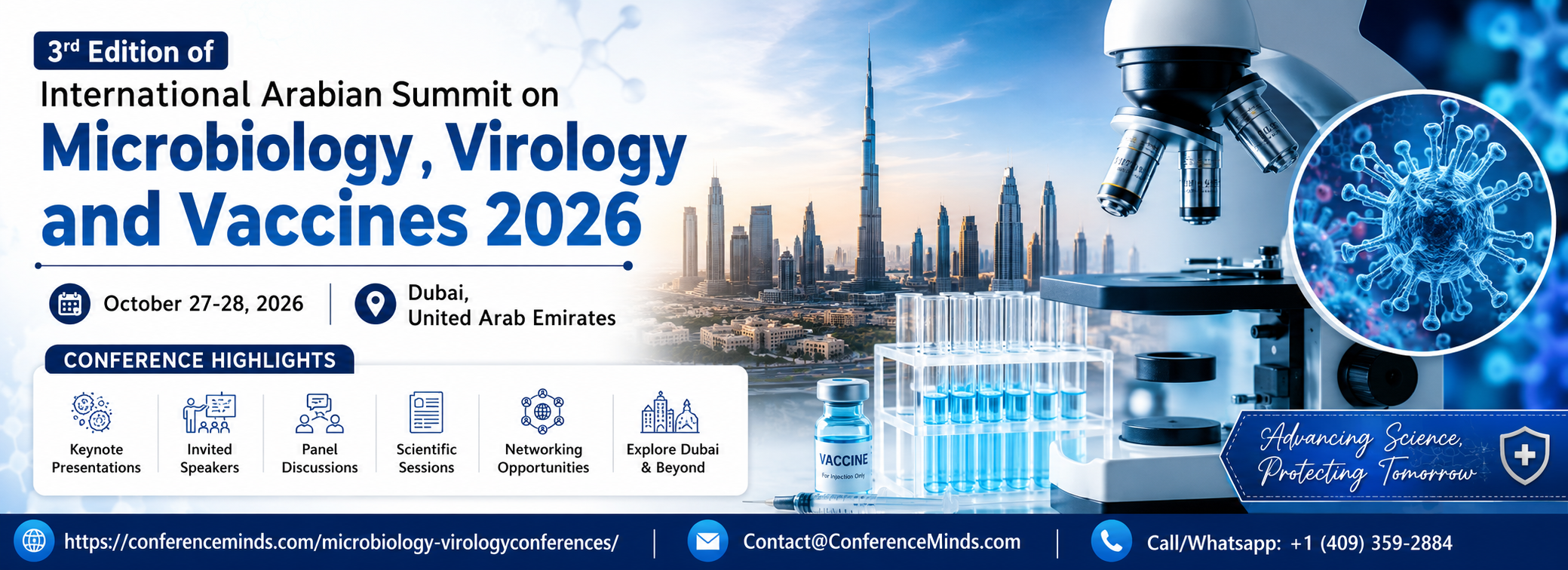
3rd Edition of International Arabian Summit
ON
Microbiology, Virology and Vaccines 2026
Event Date
October 27-28, 2026
Venue
Dubai, United Arab Emirates
– Previous Conference Performers / Professionals From Around The Globe –







































Media Partners/Collaborator
A huge thanks to all our amazing partners. We couldn’t have a conference without you!










Sponsors/Exhibitors
A huge thanks to all our amazing partners. We couldn’t have a conference without you!
About the Conference
The 3rd Edition of International Arabian Summit on Microbiology, Virology and Vaccines 2026 will bring together scientists, microbiologists, virologists, immunologists, epidemiologists, healthcare professionals, researchers, academicians, pharmaceutical experts, biotechnology professionals, and industry leaders to exchange knowledge and explore recent advances in microbiology, virology, infectious diseases, vaccines, immunology, and related biomedical sciences.
The summit will provide an international platform for presenting innovative research, discussing emerging infectious diseases, examining advances in pathogen detection and characterization, and exploring new approaches to vaccine development and disease prevention. Through keynote lectures, scientific sessions, oral presentations, poster presentations, panel discussions, and interactive networking opportunities, participants will have the opportunity to share experiences and establish professional collaborations.
The scientific program will cover a broad spectrum of topics, ranging from fundamental microbiology and microbial genomics to viral pathogenesis, antimicrobial resistance, vaccine technologies, immunization strategies, molecular diagnostics, emerging and re-emerging infections, and public-health preparedness.
Particular attention will be given to rapidly developing areas such as next-generation sequencing, artificial intelligence in infectious-disease research, mRNA and recombinant vaccine platforms, personalized immunology, microbiome research, antimicrobial stewardship, and novel diagnostic technologies.
The conference is intended to facilitate meaningful scientific dialogue between academia, healthcare institutions, research organizations, biotechnology companies, pharmaceutical industries, and public-health organizations. Participants can explore current challenges, discuss research findings, identify opportunities for collaboration, and gain insights into developments shaping the future of infectious-disease prevention and treatment.
Set in Dubai, UAE, the summit also provides an opportunity for international delegates to connect with researchers and professionals from the Middle East, Asia, Europe, Africa, and other regions while experiencing one of the world’s leading international destinations for business, science, innovation, and tourism.
Conference Benefits
Participation in the 3rd Edition of International Arabian Summit on Microbiology, Virology and Vaccines 2026 provides an opportunity to engage with an international scientific community and stay informed about developments across microbiology, virology, immunology, vaccines, diagnostics, and infectious diseases.
Delegates can present their research, receive feedback from fellow professionals, and discuss emerging scientific approaches with researchers from different institutions and countries. The conference also provides opportunities to attend keynote presentations, scientific sessions, panel discussions, oral presentations, and poster sessions covering diverse areas of infectious-disease research.
The summit encourages professional networking and international collaboration among scientists, physicians, researchers, academicians, laboratory professionals, pharmaceutical and biotechnology representatives, and public-health specialists.
Participants can explore developments in vaccine research, microbial genomics, molecular diagnostics, antimicrobial resistance, emerging pathogens, immunology, and innovative approaches to infectious-disease prevention.
Additional benefits include:
- International scientific networking opportunities
- Opportunities for oral and poster presentations
- Keynote and invited expert lectures
- Scientific panel discussions
- Exposure to current research and technologies
- Opportunities for academic and research collaborations
- Interaction with pharmaceutical and biotechnology professionals
- Knowledge exchange with international delegates
- Opportunities to discuss research challenges and future directions
- Certificate of participation/presentation
- Conference proceedings and abstract publication opportunities, where applicable
The summit is designed to create an engaging environment where participants can learn, communicate, collaborate, and develop professional connections extending beyond the conference.
Sessions & Tracks
1. General Microbiology
Fundamental and applied aspects of microbiology, including bacterial physiology, microbial growth, microbial diversity, microbial ecology, and contemporary laboratory approaches.
2. Clinical Microbiology
Recent developments in the identification, characterization, and clinical management of bacterial, viral, fungal, and parasitic infections.
3. Medical Microbiology
Research involving microorganisms associated with human disease, host–microbe interactions, laboratory diagnosis, infection prevention, and therapeutic strategies.
4. Virology and Viral Diseases
Advances in viral biology, viral replication, pathogenesis, host interactions, viral evolution, and the diagnosis and management of viral infections.
5. Emerging and Re-emerging Infectious Diseases
Scientific developments surrounding newly emerging pathogens, re-emerging infections, outbreak preparedness, surveillance, and global infectious-disease threats.
6. Vaccine Research and Development
Innovations in vaccine discovery, antigen selection, vaccine formulation, preclinical research, clinical development, evaluation, and deployment.
7. Next-Generation Vaccines
New vaccine platforms including mRNA, recombinant, viral-vector, DNA, nanoparticle, protein-subunit, and other emerging technologies.
8. Immunology and Immune Responses
Research into innate and adaptive immunity, immune regulation, host–pathogen interactions, immunological memory, and vaccine-induced immune responses.
9. Antimicrobial Resistance
Current research on antimicrobial-resistant microorganisms, mechanisms of resistance, surveillance, antimicrobial stewardship, and strategies for combating drug-resistant infections.
10. Molecular Microbiology
Molecular mechanisms underlying microbial physiology, pathogenicity, gene regulation, microbial genetics, and molecular interactions between pathogens and hosts.
11. Microbial Genomics and Metagenomics
Applications of genome sequencing, comparative genomics, metagenomics, genomic surveillance, and bioinformatics in infectious-disease research.
12. Molecular Diagnostics
Innovative diagnostic approaches including PCR, real-time PCR, sequencing, CRISPR-based diagnostics, biosensors, rapid testing, and other molecular technologies.
13. Infectious Disease Epidemiology
Epidemiological investigation, disease surveillance, transmission dynamics, outbreak investigation, risk assessment, and population-level approaches to infection control.
14. One Health and Zoonotic Diseases
The relationship between human, animal, and environmental health, with emphasis on zoonotic infections, cross-species transmission, surveillance, and prevention.
15. Microbiome and Human Health
Research on the human microbiome, microbial communities, host–microbiome interactions, microbiome-associated diseases, and therapeutic opportunities.
16. Hospital-Acquired Infections
Prevention, surveillance, diagnosis, and management of healthcare-associated infections, including infection-control strategies and antimicrobial stewardship.
17. Viral Immunology
Immune responses to viral pathogens, mechanisms of viral immune evasion, antiviral immunity, immunopathology, and vaccine-induced viral immunity.
18. Antiviral Research and Therapeutics
Discovery and development of antiviral agents, therapeutic targets, drug resistance, combination therapies, and emerging treatment strategies.
19. Public Health and Vaccination Programs
Population-level immunization strategies, vaccine access, immunization policies, vaccine delivery, surveillance, and approaches to improving vaccination coverage.
20. Pediatric Infectious Diseases
Infectious diseases affecting infants and children, pediatric vaccines, childhood immunization, emerging infections, and approaches to diagnosis and treatment.
21. Food and Environmental Microbiology
Microbial contamination, foodborne pathogens, environmental microorganisms, water microbiology, food safety, and microbial monitoring.
22. Pharmaceutical Microbiology
Microbiological quality control, contamination control, sterile manufacturing, microbial testing, pharmaceutical products, and regulatory considerations.
23. Biotechnology and Microbial Innovation
Applications of biotechnology in microbial research, vaccine development, diagnostics, therapeutics, synthetic biology, and industrial microbiology.
24. Artificial Intelligence and Digital Technologies in Infectious Diseases
Applications of AI, machine learning, computational biology, bioinformatics, and digital technologies in pathogen detection, outbreak prediction, drug discovery, and vaccine research.
25. Future Perspectives in Microbiology, Virology and Vaccines
A forward-looking forum examining emerging technologies, research priorities, unresolved challenges, global preparedness, and future directions in infectious-disease science and vaccine innovation.
Market Analysis
The global landscape of microbiology, virology, infectious diseases, diagnostics, and vaccines continues to develop rapidly, supported by advances in biotechnology, genomics, molecular diagnostics, immunology, pharmaceutical research, and public-health infrastructure. Increasing scientific attention toward emerging infectious diseases and antimicrobial resistance has created demand for improved surveillance, rapid diagnostic technologies, novel therapeutics, and effective prevention strategies.
The vaccine sector has also undergone substantial technological development, with research extending beyond conventional vaccine approaches toward mRNA, recombinant, viral-vector, nanoparticle, protein-based, and other next-generation platforms. These developments have expanded opportunities for collaboration between academic institutions, biotechnology companies, pharmaceutical manufacturers, research organizations, and healthcare systems.
At the same time, antimicrobial resistance remains a significant area of international scientific and public-health concern. The need for new antimicrobial strategies, improved diagnostics, surveillance systems, antimicrobial stewardship, and alternative therapeutic approaches continues to stimulate research and innovation.
The Middle East represents an important environment for scientific exchange because of its expanding healthcare infrastructure, research capabilities, biotechnology interests, and international connections. Dubai in particular serves as a major regional center connecting organizations and professionals from the Middle East, Asia, Europe, and Africa.
Growing interest in precision medicine, genomic surveillance, microbiome research, artificial intelligence, computational biology, and rapid molecular diagnostics is creating additional opportunities across the infectious-disease research ecosystem. Integration between academic research and commercial innovation is increasingly important for translating scientific discoveries into diagnostic, therapeutic, and preventive applications.
The summit provides a platform for professionals to examine these developments from scientific, clinical, technological, pharmaceutical, and public-health perspectives. Researchers can present new findings, while industry representatives can discuss emerging technologies and applications. Academic and professional networking may also facilitate collaborations, knowledge exchange, technology development, and future research initiatives.
Overall, continued investment in infectious-disease research, vaccine technologies, diagnostics, biotechnology, and healthcare preparedness is contributing to a dynamic scientific environment. The 3rd Edition of International Arabian Summit on Microbiology, Virology and Vaccines 2026 is positioned as a forum for discussing these developments and connecting the international scientific community with regional research and healthcare networks.
Discover Dubai, UAE
Dubai is a globally connected city known for its modern infrastructure, international business environment, multicultural population, and extensive connections to destinations across the Middle East, Asia, Europe, and Africa. Its strategic geographic location makes it an accessible destination for international conferences and scientific meetings.
The city combines a highly developed business environment with internationally recognized attractions, contemporary architecture, cultural experiences, shopping, entertainment, and hospitality. International visitors can experience landmarks such as the Burj Khalifa, explore the Dubai Marina, visit Palm Jumeirah, discover the traditional Al Fahidi Historical Neighbourhood, or enjoy the city’s extensive shopping and dining options.
Dubai’s international airport connectivity and extensive hotel infrastructure make it a popular destination for business events and international gatherings. The city offers a wide range of accommodation, restaurants, transportation options, conference facilities, and leisure activities suitable for visitors from different countries.
For conference participants, Dubai also provides opportunities to combine scientific engagement with cultural and professional experiences. Delegates can meet colleagues from different regions during the summit and explore the city’s diverse international community outside the scientific program.
The city’s blend of modern infrastructure, international connectivity, hospitality, and attractions creates a distinctive setting for the 3rd Edition of International Arabian Summit on Microbiology, Virology and Vaccines 2026.
With two days of scientific presentations, expert discussions, networking, and knowledge exchange, the summit offers participants an opportunity to engage with developments in microbiology, virology, vaccines, immunology, diagnostics, and infectious diseases while experiencing Dubai as an international destination.
– Tracks & Key Topics –
- Microbiology
- Virology
- Vaccines
- Microbiology Conference
- Virology Conference
- Vaccine Conference
- Microbiology Conference 2026
- Virology Conference 2026
- Vaccine Conference 2026
- International Microbiology Conference
- International Virology Conference
- International Vaccine Conference
- Microbiology Summit
- Virology Summit
- Vaccine Summit
- Infectious Diseases Conference
- Infectious Disease Research
- Clinical Microbiology
- Medical Microbiology
- Molecular Microbiology
- Microbial Genetics
- Microbial Genomics
- Microbial Pathogenesis
- Microbial Biotechnology
- Bacteriology
- Bacterial Infections
- Viral Infections
- Viral Diseases
- Viral Pathogenesis
- Viral Immunology
- Emerging Infectious Diseases
- Re-emerging Infectious Diseases
- Emerging Viruses
- Viral Epidemiology
- Infectious Disease Epidemiology
- Vaccine Development
- Vaccine Research
- Vaccine Technology
- Vaccine Innovation
- Next Generation Vaccines
- mRNA Vaccines
- Recombinant Vaccines
- DNA Vaccines
- Viral Vector Vaccines
- Protein-Based Vaccines
- Nanoparticle Vaccines
- Therapeutic Vaccines
- Preventive Vaccines
- Immunization
- Immunology Conference
- Immunology Research
- Host Pathogen Interactions
- Antimicrobial Resistance
- Antibiotic Resistance
- Antimicrobial Stewardship
- Antiviral Research
- Antiviral Therapies
- Infectious Disease Diagnostics
- Molecular Diagnostics
- Rapid Diagnostics
- PCR Diagnostics
- Next Generation Sequencing
- Genomic Surveillance
- Metagenomics
- Microbiome Research
- Human Microbiome
- Clinical Virology
- Viral Genomics
- Viral Evolution
- Viral Molecular Biology
- Public Health Microbiology
- Public Health Vaccination
- Global Vaccination
- Vaccination Programs
- Vaccine Safety
- Vaccine Efficacy
- Vaccine Immunogenicity
- Vaccine Manufacturing
- Pharmaceutical Microbiology
- Industrial Microbiology
- Environmental Microbiology
- Food Microbiology
- One Health
- Zoonotic Diseases
- Hospital Acquired Infections
- Infection Prevention
- Infection Control
- Microbial Biotechnology
- Biotechnology Conference
- Infectious Disease Research Conference
- Microbiology Research Conference
- Virology Research Conference
- Vaccine Research Conference
- Microbiology and Virology Summit
- Microbiology Virology and Vaccines
- Microbiology Virology and Vaccines Conference
- Microbiology Virology and Vaccines Summit
- Microbiology Virology and Vaccines 2026
- International Arabian Summit Microbiology Virology Vaccines
- Microbiology Virology and Vaccines Conference Dubai