
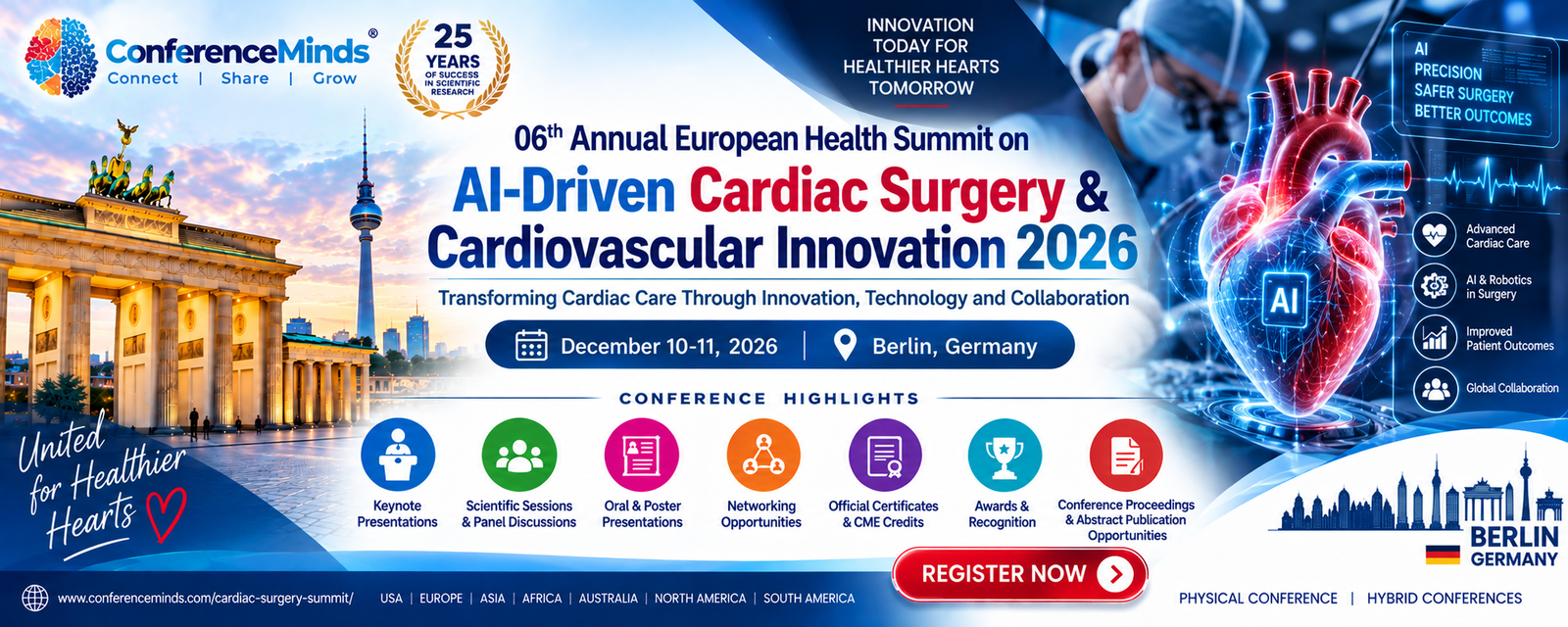
06th Annual European Health Summit
ON
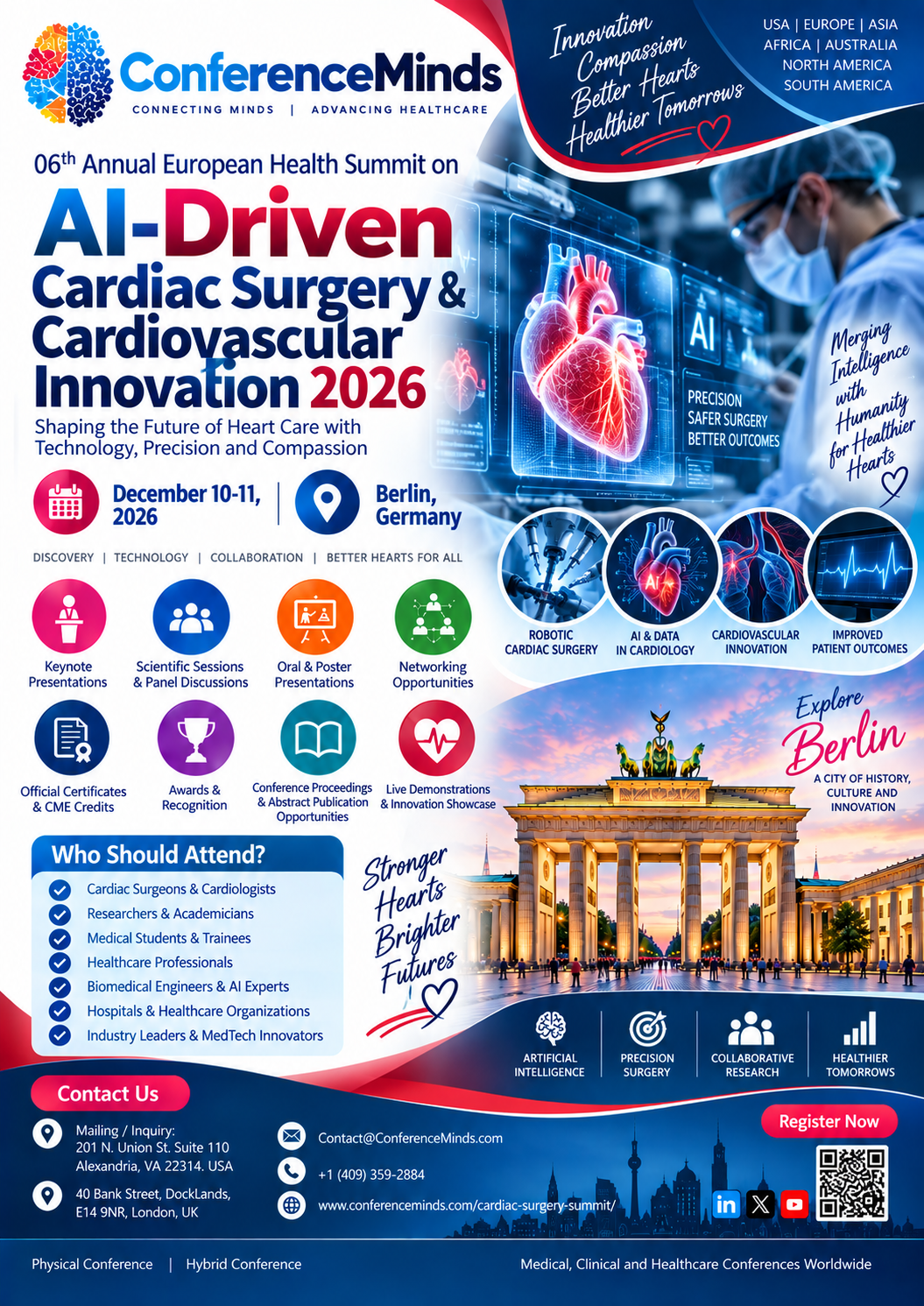
AI-Driven Cardiac Surgery & Cardiovascular Innovation 2026
Event Date
December 10-11, 2026
Venue
Berlin, Germany
– Previous Conference Performers / Professionals From Around The Globe –








































Media Partners/Collaborator
A huge thanks to all our amazing partners. We couldn’t have a conference without you!










Sponsors/Exhibitors
A huge thanks to all our amazing partners. We couldn’t have a conference without you!
About the Conference
The 06th Annual European Health Summit on AI-Driven Cardiac Surgery & Cardiovascular Innovation 2026 will take place on December 10–11, 2026, in Berlin, Germany, bringing together cardiac surgeons, cardiologists, cardiovascular researchers, biomedical engineers, healthcare professionals, technology innovators, and industry representatives. The summit will focus on the rapidly developing intersection of artificial intelligence, cardiac surgery, cardiovascular medicine, robotics, medical imaging, digital health, and precision care.
The conference will feature keynote presentations, scientific sessions, panel discussions, oral presentations, poster sessions, technology showcases, and networking opportunities. Participants will have opportunities to exchange research findings, discuss clinical challenges, explore emerging technologies, and develop international collaborations in cardiovascular medicine.
Sessions and Tracks
1. AI in Cardiac Surgery
Exploring applications of artificial intelligence in surgical decision-making, risk assessment, operative planning, and postoperative management.
2. Robotic Cardiac Surgery
Discussing robotic-assisted procedures, minimally invasive approaches, surgical navigation, and technological developments in robotic platforms.
3. AI-Powered Cardiovascular Imaging
Examining AI applications in echocardiography, cardiac CT, cardiac MRI, angiography, and automated image interpretation.
4. Precision Cardiovascular Medicine
Exploring personalized treatment strategies based on clinical, imaging, genomic, and other patient-specific data.
5. Machine Learning in Cardiology
Discussing machine-learning models for diagnosis, prognosis, risk prediction, patient monitoring, and clinical decision support.
6. Advanced Heart Valve Surgery
Covering innovations in valve repair and replacement, minimally invasive procedures, structural heart interventions, and patient selection.
7. Transcatheter Heart Valve Interventions
Focusing on TAVI/TAVR, transcatheter mitral and tricuspid procedures, procedural imaging, and evolving intervention strategies.
8. Coronary Artery Bypass Surgery
Discussing contemporary CABG techniques, arterial grafting, minimally invasive approaches, surgical outcomes, and patient optimization.
9. Mechanical Circulatory Support
Exploring ventricular assist devices, artificial hearts, extracorporeal support, device monitoring, and emerging mechanical circulatory technologies. Berlin’s DHZC has extensive experience with mechanical circulatory assistance systems.
10. Heart and Lung Transplantation
Reviewing advances in transplantation, donor management, recipient selection, immunological considerations, and post-transplant care.
11. Cardiovascular Robotics and Automation
Examining automation, robotic navigation, computer-assisted surgery, and intelligent surgical systems.
12. Digital Twins in Cardiovascular Medicine
Exploring virtual patient models, cardiovascular simulation, predictive modeling, and personalized treatment planning. Research at Berlin’s Institute of Computer-Assisted Cardiovascular Medicine includes cardiovascular modeling, simulation, and AI-supported methods.
13. AI in Cardiac Risk Prediction
Discussing predictive algorithms for cardiovascular events, postoperative complications, mortality, and long-term patient outcomes.
14. Cardiovascular Critical Care
Addressing advanced intensive care, hemodynamic monitoring, postoperative complications, organ support, and AI-assisted critical-care systems.
15. Congenital Heart Surgery
Exploring innovative surgical approaches for congenital heart disease in neonates, children, adolescents, and adults.
16. Pediatric Cardiac Innovation
Focusing on advanced imaging, minimally invasive procedures, surgical technologies, and personalized treatment for pediatric patients.
17. Artificial Intelligence in Cardiovascular Diagnostics
Examining AI-enabled diagnostic tools, automated screening, clinical decision support, and early detection of cardiovascular disease.
18. Wearable Technology and Remote Monitoring
Discussing smart devices, wearable sensors, remote cardiac monitoring, digital biomarkers, and home-based cardiovascular care.
19. Telecardiology and Digital Cardiac Care
Exploring telemedicine platforms, virtual consultations, remote diagnostics, and digitally enabled cardiovascular services.
20. Cardiovascular Data Science
Discussing big data, clinical databases, multimodal datasets, data integration, predictive analytics, and reproducible cardiovascular research.
21. AI Ethics, Safety and Clinical Validation
Examining transparency, bias, explainability, patient privacy, clinical validation, regulatory considerations, and responsible implementation of AI.
22. Next-Generation Cardiovascular Devices
Highlighting innovations in stents, valves, pumps, monitoring systems, implantable devices, and smart cardiovascular technologies.
23. Advanced Cardiac Anesthesia and Perioperative Care
Discussing AI-supported anesthesia, intraoperative monitoring, perioperative risk assessment, enhanced recovery, and critical-care coordination.
24. Translational Cardiovascular Research
Connecting laboratory discoveries with clinical applications, emerging technologies, biomaterials, computational medicine, and innovative therapies.
25. Future of AI-Driven Cardiovascular Medicine
A forward-looking session addressing emerging technologies, interdisciplinary collaboration, personalized care, intelligent surgical systems, and the future evolution of cardiovascular healthcare.
Market Analysis
The global cardiovascular healthcare landscape is being shaped by the continuing burden of cardiovascular disease, advances in minimally invasive procedures, increasing adoption of digital health technologies, and growing interest in artificial intelligence. Within cardiac surgery and cardiovascular medicine, AI is increasingly being investigated for applications including medical imaging, risk prediction, clinical decision support, surgical planning, patient monitoring, and personalized treatment.
AI-enabled cardiovascular imaging represents an important area of technological development. Algorithms can assist clinicians in analyzing complex imaging datasets and identifying patterns that may support diagnosis, prognosis, and treatment planning. At the same time, advances in computer-assisted cardiovascular medicine are creating opportunities to combine imaging, clinical information, modeling, and AI-based analytics. Berlin’s DHZC specifically identifies cardiovascular computer-assisted medicine, cardiovascular imaging, telemedicine, and AI in medicine among its areas of activity.
The cardiac surgery market is also experiencing technological changes through robotic surgery, minimally invasive procedures, mechanical circulatory support, advanced surgical navigation, and digitally integrated operating environments. Specialized centers are developing multidisciplinary approaches that combine cardiac surgery, cardiology, imaging, intensive care, engineering, and data science.
Europe represents an important environment for these developments because of its established healthcare infrastructure, research institutions, medical-device ecosystem, and regulatory focus on clinical safety and responsible technology adoption. Germany, in particular, has a strong scientific and clinical ecosystem, while Berlin provides access to major academic and healthcare institutions.
The future market opportunity is likely to depend not only on technological capability but also on clinical validation, interoperability, cybersecurity, regulatory compliance, cost-effectiveness, and physician adoption. Conferences such as this summit can facilitate collaboration between clinicians, researchers, technology developers, medical-device companies, and healthcare organizations as these technologies move from research into clinical practice.
Venue
Berlin, the capital of Germany, is a vibrant international city known for its rich history, cultural diversity, scientific excellence, and modern innovation. As one of Europe’s most influential cities, Berlin offers an ideal setting for international conferences, academic meetings, healthcare summits, and professional networking events.
The city combines historic landmarks with contemporary architecture, world-class research institutions, universities, hospitals, museums, and technology companies. Visitors can explore iconic attractions such as the Brandenburg Gate, Reichstag Building, Museum Island, Berlin Cathedral, and the Berlin Wall Memorial. Berlin’s diverse culinary scene, lively neighborhoods, parks, and cultural events also provide an enjoyable experience beyond conference activities.
Berlin is well connected to major European and international destinations through Berlin Brandenburg Airport and an extensive public transportation network of trains, trams, buses, and underground services. Its efficient infrastructure makes it convenient for delegates traveling from different countries.
For healthcare and scientific professionals, Berlin provides opportunities to connect with researchers, clinicians, academics, industry experts, and institutions from Germany and around the world. The city’s international atmosphere and strong academic and research environment make it a suitable destination for knowledge exchange, collaboration, and professional networking.
With its combination of history, innovation, culture, research, and international connectivity, Berlin offers conference participants both a productive professional environment and an enriching European travel experience.