
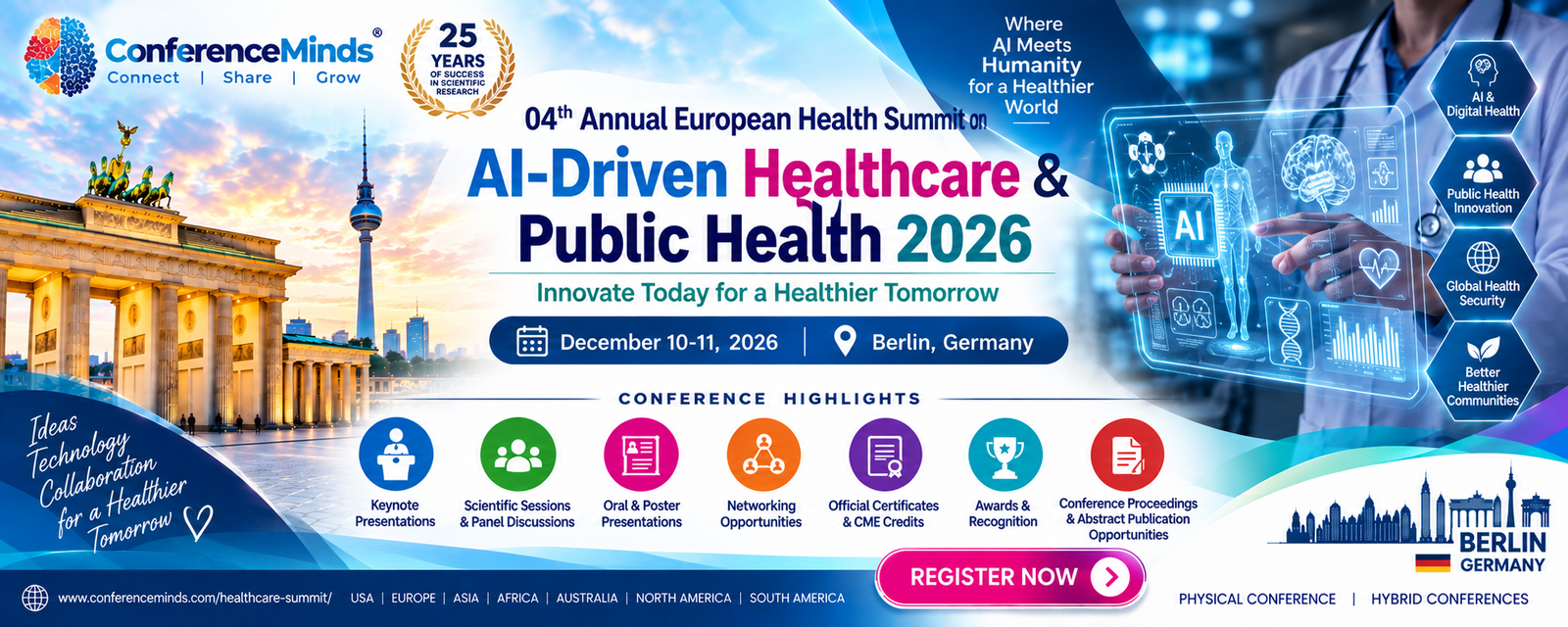
04th Annual European Health Summit
on
AI-Driven Healthcare & Public Health 2026
Event Date
December 10-11, 2026
Venue
Berlin, Germany
– Previous Conference Performers / Professionals From Around The Globe –










































Media Partners/Collaborator
A huge thanks to all our amazing partners. We couldn’t have a conference without you!










Sponsors/Exhibitors
A huge thanks to all our amazing partners. We couldn’t have a conference without you!
About the Conference
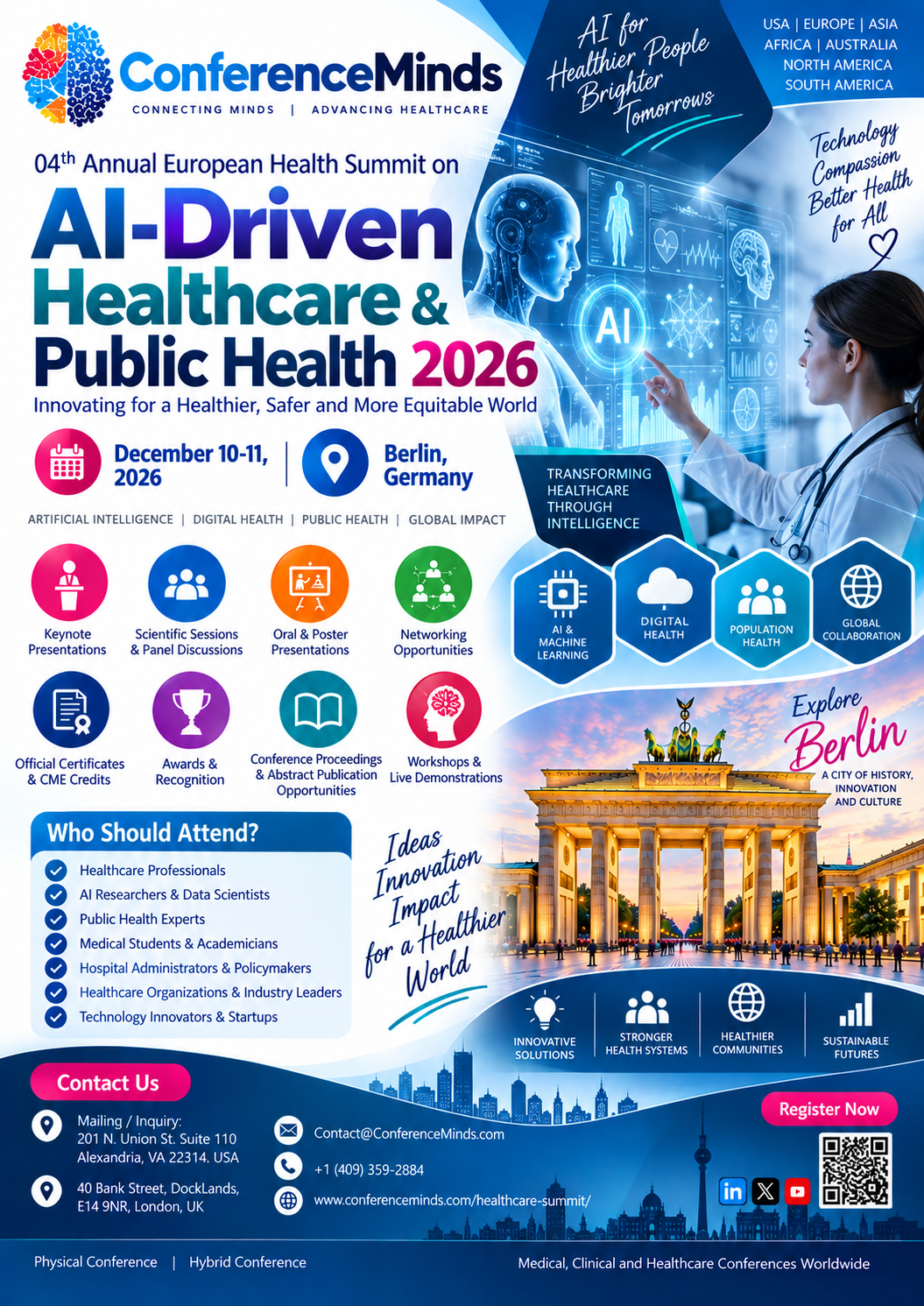
The 04th Annual European Health Summit on AI-Driven Healthcare & Public Health 2026 will bring together healthcare professionals, public health experts, researchers, clinicians, policymakers, technology specialists, data scientists, healthcare executives, academics, and industry leaders to explore how artificial intelligence is transforming healthcare delivery and population health.
The summit will focus on practical and emerging applications of AI across clinical medicine, diagnostics, disease prevention, epidemiology, health data management, medical research, digital health, and healthcare administration. Key discussions will examine machine learning, generative AI, predictive analytics, clinical decision-support systems, AI-assisted diagnostics, remote monitoring, precision medicine, and population-health intelligence.
The European healthcare landscape is undergoing rapid digital transformation. A 2026 European Commission study reports that 94% of healthcare providers surveyed are already using or planning to adopt AI solutions, while the European digital health market is projected to grow substantially through 2035.
The conference will also address responsible AI, data privacy, cybersecurity, regulatory compliance, health equity, transparency, interoperability, and the importance of maintaining human oversight in AI-enabled healthcare.
The event provides an international platform for knowledge exchange, scientific presentations, networking, collaborations, and discussion of practical strategies for integrating AI into sustainable and patient-centered healthcare systems.
Sessions and Tracks
1. Artificial Intelligence in Modern Healthcare
Overview of AI applications transforming clinical practice, healthcare administration, research, and patient services.
2. Machine Learning in Clinical Medicine
Exploration of machine-learning algorithms for diagnosis, prognosis, risk prediction, and clinical decision support.
3. Generative AI in Healthcare
Discussion of large language models, generative AI applications, medical documentation, clinical assistance, and emerging opportunities.
4. AI-Assisted Medical Diagnosis
Applications of AI in identifying diseases and abnormalities from clinical information, imaging, laboratory results, and other health data.
5. Predictive Analytics & Risk Stratification
Use of predictive models to identify high-risk patients, anticipate disease progression, and support preventive interventions.
6. AI in Public Health Surveillance
Applications of AI for disease surveillance, outbreak detection, population monitoring, and public-health intelligence.
7. Digital Health & Connected Care
The integration of digital platforms, mobile technologies, telehealth, remote monitoring, and AI-enabled healthcare services.
8. Electronic Health Records & Intelligent Data Systems
AI-driven approaches to extracting, organizing, analyzing, and interpreting information from electronic health records.
9. Big Data Analytics in Healthcare
Use of large-scale healthcare datasets to identify trends, generate evidence, improve resource planning, and support research.
10. AI in Epidemiology
Application of computational models and AI techniques to understand disease patterns, transmission, risk factors, and population-level trends.
11. Precision Medicine & Personalized Healthcare
How AI and advanced analytics can support individualized prevention, diagnosis, treatment selection, and patient management.
12. AI in Medical Imaging
Machine-learning and computer-vision approaches for radiology, pathology, imaging analysis, screening, and clinical workflow support.
13. AI in Drug Discovery & Development
Applications of AI in target identification, drug discovery, molecular modelling, clinical development, and therapeutic research.
14. Digital Biomarkers & Remote Patient Monitoring
Use of wearable devices, sensors, mobile applications, and AI analytics to monitor health continuously outside traditional clinical settings.
15. AI for Chronic Disease Management
Applications in diabetes, cardiovascular disease, respiratory conditions, cancer, and other chronic diseases.
16. AI for Population Health Management
Using data-driven technologies to identify population needs, improve prevention strategies, allocate resources, and support health outcomes.
17. AI, Health Equity & Access
Discussion of digital inequalities, algorithmic bias, accessibility, underserved populations, and equitable deployment of AI technologies.
18. Healthcare Data Privacy & Cybersecurity
Strategies for protecting sensitive health information and strengthening cybersecurity within increasingly connected healthcare systems.
19. Responsible & Ethical AI
Examination of transparency, accountability, explainability, human oversight, fairness, and responsible AI implementation.
20. AI Regulation & Healthcare Governance
Discussion of regulatory frameworks, risk management, compliance requirements, and governance of AI-enabled medical technologies.
21. Interoperability & European Health Data
Exploration of interoperable systems and cross-border health-data exchange supporting research and healthcare delivery.
22. AI in Healthcare Workforce & Education
How AI is changing healthcare roles, professional education, clinical workflows, workforce development, and skills requirements.
23. AI Startups & Health-Tech Innovation
Showcase of emerging technologies, healthcare startups, innovative business models, and commercialization opportunities.
24. AI for Healthcare Sustainability
Applications of intelligent systems to improve operational efficiency, resource utilization, care coordination, and sustainable healthcare delivery.
25. Future of AI-Driven Healthcare & Public Health
Forward-looking discussions on emerging technologies, research priorities, international collaboration, and the future evolution of AI-enabled health systems.
Market Analysis
Artificial intelligence is becoming an increasingly important component of healthcare transformation in Europe. The European Commission’s 2026 study of digital health technologies estimates that the EU digital health market could increase from approximately €11 billion in 2023 to €61.2 billion by 2035, representing a projected compound annual growth rate of 15.1%. The study also identifies clinical decision support, early diagnosis, patient engagement, and remote monitoring among important AI applications.
Healthcare organizations are adopting AI partly in response to increasing healthcare demand, workforce pressures, rising chronic disease burdens, and the need to improve efficiency. European Commission reporting indicates that investment in health-related ICT has increased by approximately 30% since 2021, while European health systems are simultaneously expanding electronic health records, e-prescriptions, AI integration, and digital governance.
Germany represents an important environment for this transformation. The country’s health system combines extensive healthcare infrastructure with significant pharmaceutical research capacity and continuing digitalization efforts. The 2025 Germany Country Health Profile notes that Germany has expanded electronic patient-file access and continues efforts to modernize healthcare delivery and address inefficiencies.
The market opportunity extends across hospitals, pharmaceutical companies, biotechnology, medical-device manufacturers, diagnostics, health-tech startups, insurance, research institutions, and public-health organizations. AI-supported imaging, clinical decision support, predictive analytics, drug discovery, remote monitoring, and administrative automation are creating opportunities for technology providers and healthcare organizations.
At the same time, market development depends on responsible implementation. Data protection, interoperability, cybersecurity, regulatory compliance, algorithmic transparency, workforce training, and equitable access remain important considerations. The European Health Data Space and evolving European AI regulatory environment are contributing to the broader framework for digital healthcare development.
Against this background, the Berlin summit provides a platform for researchers, healthcare organizations, technology companies, policymakers, and investors to examine opportunities, challenges, implementation strategies, and emerging directions in AI-driven healthcare and public health.
Venue
Berlin, the capital of Germany, is a vibrant international city known for its rich history, cultural diversity, scientific excellence, and modern innovation. As one of Europe’s most influential cities, Berlin offers an ideal setting for international conferences, academic meetings, healthcare summits, and professional networking events.
The city combines historic landmarks with contemporary architecture, world-class research institutions, universities, hospitals, museums, and technology companies. Visitors can explore iconic attractions such as the Brandenburg Gate, Reichstag Building, Museum Island, Berlin Cathedral, and the Berlin Wall Memorial. Berlin’s diverse culinary scene, lively neighborhoods, parks, and cultural events also provide an enjoyable experience beyond conference activities.
Berlin is well connected to major European and international destinations through Berlin Brandenburg Airport and an extensive public transportation network of trains, trams, buses, and underground services. Its efficient infrastructure makes it convenient for delegates traveling from different countries.
For healthcare and scientific professionals, Berlin provides opportunities to connect with researchers, clinicians, academics, industry experts, and institutions from Germany and around the world. The city’s international atmosphere and strong academic and research environment make it a suitable destination for knowledge exchange, collaboration, and professional networking.
With its combination of history, innovation, culture, research, and international connectivity, Berlin offers conference participants both a productive professional environment and an enriching European travel experience.