
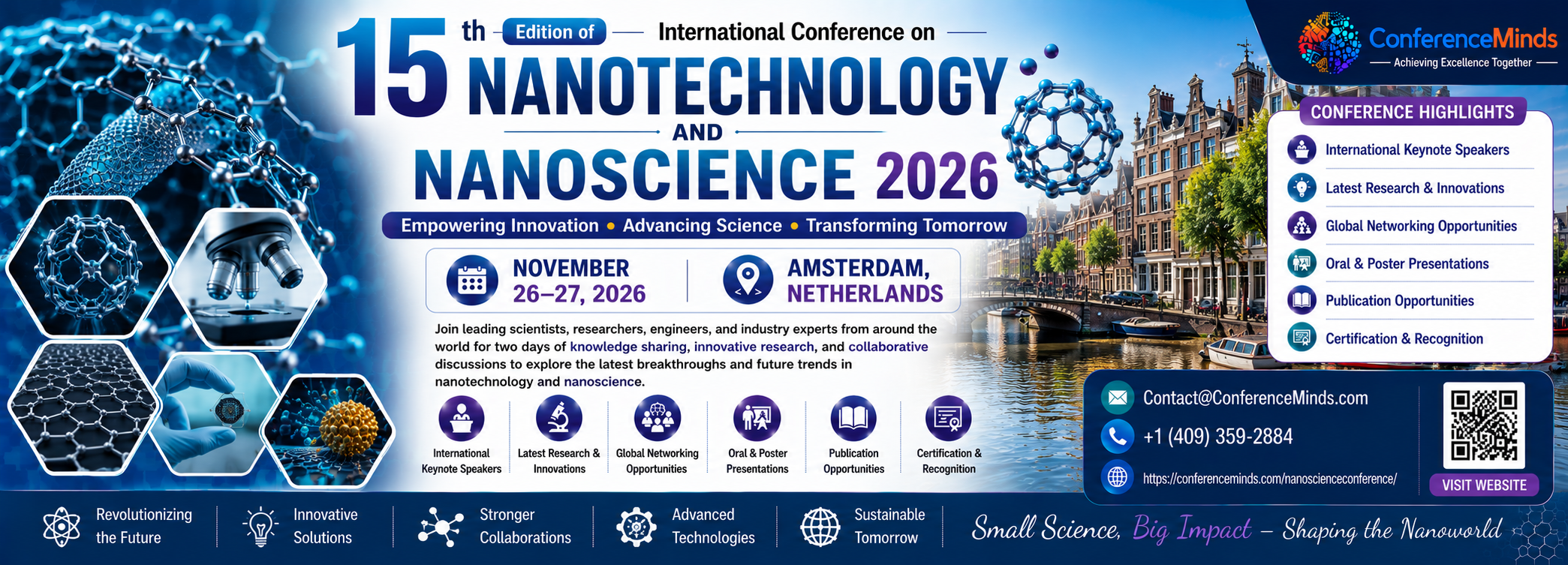
15th Edition of International Conference
ON
Nanotechnology and Nanoscience
Event Date
November 26-27, 2026
Venue
Amsterdam, Netherlands
– Previous Conference Performers / Professionals From Around The Globe –










































Media Partners/Collaborator
A huge thanks to all our amazing partners. We couldn’t have a conference without you!










Sponsors/Exhibitors
A huge thanks to all our amazing partners. We couldn’t have a conference without you!
About Conference
The 15th Edition of the International Conference on Nanotechnology and Nanoscience will take place on November 26-27, 2026 inAmsterdam, Netherlands, bringing together scientists, researchers, engineers, and industry professionals from around the world. The conference will highlight the latest innovations in nanotechnology, nanomaterials, nanoscience research, and advanced applications in medicine, electronics, and materials science. Experts will present cutting-edge research, technological developments, and emerging trends in the nanotechnology field. This global event provides an excellent platform for scientific exchange, collaboration, and networking in nanoscience and advanced technology.
This conference aims to spotlight transformative research achievements, encourage cross-disciplinary knowledge sharing, and facilitate partnerships that accelerate nanotechnology adoption in science and industry.
Why Attend
Attending the 15th International Conference on Nanotechnology and Nanoscience offers significant professional, academic, and commercial value. Here’s why researchers, industry practitioners, and innovators prioritize participation:
Exposure to Cutting-Edge Research
Participants will be among the first to hear about breakthroughs in nanoscale materials, devices, characterization techniques, and emerging theoretical frameworks. Presentations often include unpublished results and early-stage innovations that are shaping the direction of nanoscience.
Interdisciplinary Networking
Nanotechnology is inherently interdisciplinary, touching on physics, chemistry, biology, materials science, and engineering. The conference provides structured and informal networking opportunities with peers, potential collaborators, and thought leaders from around the world.
Professional Visibility and Recognition
Presenting your work — whether in an oral session or poster — increases visibility among peers and can lead to citations, invitations to collaborate, or even job opportunities. Best-paper awards and invited keynote slots offer additional recognition.
Practical Insights and Real-World Applications
Technical sessions and plenary talks will include real-world applications of nanotechnology to health care, energy storage, environmental monitoring, electronics, and manufacturing. This helps attendees understand not just the science, but also practical translation pathways.
Educational and Career Advancement
For students and early-career researchers, attending workshops and tutorials can strengthen foundational knowledge, offer mentorship opportunities, and enhance academic or professional profiles.
Publication and Dissemination Opportunities
Accepted contributions are often published in conference proceedings and may be eligible for submission to indexed journals, extending their reach and impact.
Industry Connections and Commercial Opportunities
Industry representation at major conferences fosters interactions on technology transfer, startup and venture interest, and partnerships between academic labs and commercial entities.
Who Should Join the Conference
The conference attracts a diverse range of participants across sectors:
Academic Researchers and Faculty
Professors and research scientists from universities worldwide present theoretical and experimental findings, discuss methodologies, and network with peers.
Graduate and Post-Doctoral Students
Doctoral and postdoctoral scholars seeking exposure, feedback on research, and career opportunities find these events invaluable.
Industry Professionals
Engineers, R&D specialists, product developers, and innovation leads from companies engaged in nanotechnology — especially in semiconductors, biomedical devices, energy storage, and materials — attend to understand trends and scout talent.
Entrepreneurs and Startup Founders
Founders of tech startups focusing on nanomaterials, nanosensors, nano-enabled medical diagnostics, and similar areas use the conference to pitch ideas, seek investors, and find collaborators.
Policy Makers and Funding Agencies
Representatives from government science agencies and funding bodies attend to gauge research direction, assess national priorities, and support strategic investments.
Investors and Venture Capitalists
Investors looking for high-impact technologies and scalable innovations in sectors like nanomedicine, quantum materials, and advanced manufacturing benefit from exposure to new research.
Technical Consultants and Analysts
Consultants working in emerging tech trends, market strategy, or technology evaluation attend to stay abreast of scientific and commercial developments.
Conference Sessions
- Nanomaterials Synthesis and Characterization
- Focuses on methods to design, synthesize, and characterize nanomaterials (e.g., nanoparticles, nanowires, 2D materials) and link nanoscale structure to properties for varied applications.
- Nanostructured Metals and Alloys
- Explores nanoscale metals, alloys, and composites with enhanced mechanical, thermal, and electrical properties for advanced electronics and structural applications.
- Nanophotonics and Plasmonics
- Covers light-matter interactions at the nanoscale, including optics in nano-structures, plasmonic enhancement, and photonic device innovations.
- Nanoelectronics and Quantum Materials
- Includes nanoscale transistors, memory devices, quantum dots, spintronics, and emerging materials for next-generation computing and communication.
- Biomedical Nanotechnology
- Discusses nanomaterials for drug delivery, diagnostics, biosensing, tissue engineering, and targeted therapeutic applications.
- Nanotechnology in Energy and Environment
- Focuses on nano-enhanced batteries, supercapacitors, photovoltaics, catalysts for clean energy and environmental remediation.
- Nanosensors and Nanoactuators
- Includes design of high-sensitivity sensors and actuators for healthcare, environmental monitoring, and the Internet of Things.
- Nano Robotics and Nanomanipulation
- Explores nano-scale robotic systems, automation, and techniques for manipulation of materials at the atomic and molecular scale.
- Nanofabrication and Lithography
- Technical methodologies for patterning and fabricating functional nanostructures using top-down and bottom-up processes.
- Computational Nanoscience and Simulation
- Emphasizes modeling tools, simulations, and machine learning approaches to predict properties and design nanosystems.
- Nanoscale Surface Engineering
- Science of surface treatments and coatings at the nanoscale to control corrosion, adhesion, friction, optical properties, and biocompatibility.
- Sustainable Nanotechnology
- Discusses eco-friendly nanomaterials, lifecycle analysis, recycling, and environmental risk mitigation of nano-products.
- Nano-Biophysics and Bionanomaterials
- Investigates fundamental biophysical interactions of nanostructures with biological systems and applications in biosensing and therapeutics.
- Nanotechnology in Aerospace and Defense
- Applications of nanomaterials in lightweight structural components, sensors, and thermal management systems in aerospace engineering.
- 2D Nanomaterials and Beyond
- Highlights research in graphene, transition-metal dichalcogenides (TMDCs), MXenes and their integration into electronics, sensors, and composites.
- Nano-Optoelectronics
- Integration of optics and electronics at the nanoscale to enable ultra-fast communication devices, photonic circuits, and display technologies.
- Quantum Nanotechnology
- Topics include quantum dots, qubits, quantum communication materials, and devices that harness quantum phenomena for computing.
- Nanosafety and Regulatory Frameworks
- Studies safety assessment, toxicology, regulatory policies, and ethical considerations for nanotechnology products and research.
- Nanotechnology Education and Outreach
- Discussions on curricula, training programs, and public engagement to strengthen nanoscience education and workforce development.
- Commercialization and Entrepreneurship in Nanotech
- Focuses on translating nanoscience discoveries into marketable products, intellectual property strategies, startup growth, and investor engagement.
Nanotechnology Market Analysis
Understanding the broader industry trends provides context for why this conference is important.
Global Market Growth
The global nanotechnology market — encompassing nanomaterials, nanosensors, devices, and application systems — is experiencing robust growth. According to industry forecasts:
- The market’s total value is projected at around USD 123.76 billion in 2026, demonstrating expansion from 2025 figures and strong momentum into the next decade.
- Forecasts suggest compounded annual growth through the 2030s as industries adopt nano-enabled solutions across healthcare, electronics, energy, and materials sectors. Drivers include improvements in diagnostics, advanced manufacturing, and pressure for miniaturization.
Key Application Sectors
- Healthcare and Diagnostics: Nanotechnology is driving innovations in targeted drug delivery, nanoscale imaging agents, cancer therapies, and biosensors. These applications are projected to remain among the fastest-growing segments because of their potential to drastically improve patient outcomes.
- Electronics and Computing: Nanoscale transistors, memory devices, and quantum materials contribute to faster, energy-efficient computing platforms.
- Energy: Nano-engineered components improve battery performance, catalytic efficiency, and solar harvesting capabilities.
- Environmental Management: Nanomaterials play roles in water purification, air filtration, and remediation technologies.
Geographic Dynamics
- Asia-Pacific remains a key manufacturing and R&D hub, with heavy investment in nanotechnology infrastructure in Japan, China, and Korea.
- North America often leads in commercialization, driven by research funding, startup activities, and an ecosystem that supports technology transfer.
- Europe emphasizes regulatory frameworks and sustainability, aligning nanotechnology development with safety and ethical standards.
These market trends highlight why the nanotechnology research community — and stakeholders across sectors — gather at large international conferences: to align scientific advances with commercial feasibility and societal impact.
Venue Description
Amsterdam, the vibrant capital of Netherlands, is one of Europe’s most captivating destinations, renowned for its picturesque canals, rich cultural heritage, innovative spirit, and welcoming international atmosphere. Built around a UNESCO World Heritage-listed canal network, the city is characterized by elegant 17th-century canal houses, charming bridges, tree-lined streets, and thousands of bicycles that create its distinctive character. Amsterdam seamlessly blends historical significance with modern innovation, making it an ideal destination for tourism, business, education, and international conferences. The city is home to globally recognized landmarks such as the Rijksmuseum, Van Gogh Museum, Anne Frank House, and the lively Dam Square, attracting millions of visitors every year. As a leading European hub for scientific research, healthcare, finance, technology, and sustainability, Amsterdam hosts numerous multinational corporations, prestigious universities, and innovative startups, fostering collaboration and knowledge exchange across diverse industries. The city offers world-class conference venues, luxury accommodations, and excellent hospitality services, making it a preferred location for international academic and professional events. Amsterdam is exceptionally well connected through Amsterdam Airport Schiphol, one of Europe’s busiest international airports, along with an efficient network of trains, trams, buses, and metro services that provide convenient access throughout the city and beyond. Visitors can enjoy scenic canal cruises, vibrant markets, diverse culinary experiences, beautiful parks, and a thriving arts and entertainment scene while experiencing the city’s safe, clean, and environmentally conscious lifestyle. With its unique combination of historical charm, cultural diversity, cutting-edge innovation, and outstanding infrastructure, Amsterdam provides an inspiring setting for researchers, healthcare professionals, entrepreneurs, and travelers alike. Whether attending a prestigious international conference, exploring its iconic museums, or simply enjoying the tranquil beauty of its canals, Amsterdam offers an unforgettable experience that perfectly balances professional opportunities with exceptional cultural enrichment.
– Tracks & Key Topics –
- Nanomaterials
- Nanoparticles
- Nanocomposites
- Nanotubes
- Nanorobots
- Nanostructures
- Quantum dots
- Nanomedicine
- Nanosensors
- Nanoelectronics
- Nanofabrication
- Molecular nanotechnology
- Nanochemistry
- Carbon nanotubes
- Gold nanoparticles
- Nanolithography
- Surface plasmon resonance
- Nanostructured materials
- Nanocapsules
- Self-assembly
- Nanoparticle synthesis
- Nanoscale
- Functional nanomaterials
- Nanorods
- Nanocoatings
- Nanoarchitecture
- Biocompatible nanomaterials
- Nanoelectronics devices
- Nanoparticle drug delivery
- Nanotexturing
- Nano-optics
- Nanoscale transistors
- Molecular motors
- Nanoclusters
- Nanoscience research
- Nano-robotics
- Nanoscale imaging
- Nanotechnology applications
- Atomic force microscopy (AFM)
- Scanning electron microscopy (SEM)
- Nanophotonics
- Nano-imprinting
- Superhydrophobic surfaces
- Nanocrystals
- Nanomagnetism
- Surface modification
- Nanobiotechnology
- Bionanotechnology
- Nanoencapsulation
- Photothermal therapy
- DNA nanotechnology
- Smart nanoparticles
- Nanoemulsions
- Carbon-based nanomaterials
- Graphene
- Fullerene
- Nanopore
- Metamaterials
- Nanoribbon
- Quantum computing
- Nanoengineering
- Nanocircuits
- Molecular self-assembly
- Atomic layer deposition
- Nano-structured films
- Nanodevices
- Electrospinning
- Nanoindentation
- Nanoplasmonics
- Nano-thin films
- Bimetallic nanoparticles
- Nanosafety
- Nanotoxicology
- SERS (Surface-enhanced Raman spectroscopy)
- Nanoparticle toxicity
- Nanocrystal growth
- Thin film deposition
- Nano-additives
- Nano-carriers
- Bioinspired nanomaterials
- Nanoelectronics integration
- Nanoimmunotherapy
- Nanopharmacology
- Nanoscale catalysis
- Bio-Nano interfaces
- Nano-manufacturing
- Quantum nanostructures
- Piezoelectric nanomaterials
- Nanofluidics
- Nano-sensors for health
- Nanomaterial toxicity
- Hybrid nanomaterials
- Nanoparticle surface charge
- Magnetic nanoparticles
- Nanosheet
- Molecular electronics
- Environmental nanotechnology
- Energy harvesting with nanomaterials
- Nanostimulation
- Photonic nanomaterials